Custom Software Development Process Explained (2026 Complete Guide)
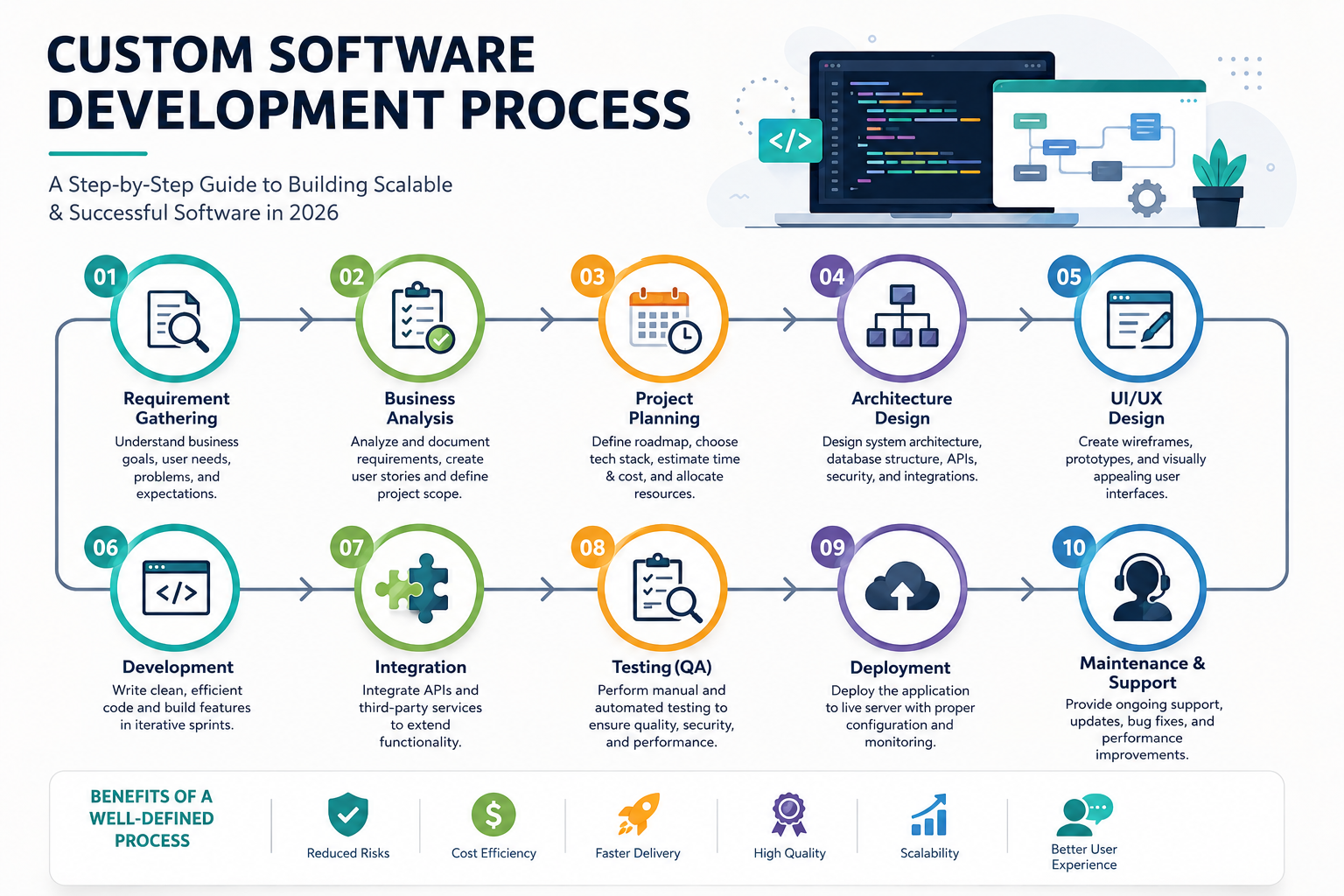

Learn the complete custom software development process from requirements gathering and architecture design to development, testing, deployment, and ongoing maintenance.
Custom Software Development Process Explained (2026 Complete Guide)
Building custom software requires a structured process to ensure the final product meets business needs, stays within budget, and is delivered on schedule. This guide walks through every phase of the custom software development lifecycle.
Phase 1: Requirements Gathering and Analysis
Before writing code, understand what needs to be built. Document current processes and pain points. Define functional requirements — what should the software do? Define non-functional requirements — performance, security, scalability, usability. Prioritize features — must-have vs nice-to-have. Create user stories and use cases. This phase prevents building the wrong thing.
Phase 2: System Architecture and Design
Design how the software will work before building it. System architecture — high-level structure, technology choices, integration points. Database design — schema, relationships, indexing strategy. API design — endpoints, data formats, authentication. UI/UX design — wireframes, prototypes, user flows. Technical decisions made here have long-term implications.
Phase 3: Development
This is where the software is actually built, typically following agile methodology with 1-2 week sprints. Each sprint delivers working, tested functionality. Regular demos keep stakeholders informed. Frontend and backend development happen in parallel. Code reviews ensure quality and consistency.
Phase 4: Testing and Quality Assurance
Thorough testing ensures reliable, bug-free software. Unit testing — individual components work correctly. Integration testing — components work together. System testing — the complete application works as specified. User acceptance testing — real users validate the software meets their needs. Performance testing — the software handles expected load. Security testing — vulnerabilities are identified and fixed.
Phase 5: Deployment
Moving software from development to production. Infrastructure provisioning — servers, databases, CDN. Data migration — moving existing data to the new system. Environment configuration — production settings, monitoring, backups. Phased rollout — gradual release to users with monitoring.
Phase 6: Maintenance and Evolution
Software development does not stop at launch. Bug fixes and patches. Performance optimization based on real-world usage. Feature enhancements driven by user feedback. Security updates. Technology upgrades to keep the stack current.
Why Choose RedGobble?
At RedGobble, we build high-performance digital products for startups, businesses, and enterprises. Our expertise includes custom website development, AI solutions, AI agent development, SaaS platforms, ERP and CRM systems, mobile app development, business automation, UI/UX design, SEO-friendly websites, and cloud deployment.
Based in Greater Noida, Uttar Pradesh, India, RedGobble provides custom software development, AI solutions, mobile app development, and web development services for businesses across India and worldwide.
Frequently Asked Questions
What is the first step in custom software development?
Requirements gathering — understanding what the software needs to do, who will use it, and what success looks like. Skipping this phase is the most common cause of project failure.
How long does custom software development take?
Simple applications take 8-16 weeks. Mid-complexity systems take 16-30 weeks. Complex enterprise solutions take 30-52+ weeks.
What methodology do you use?
We use agile methodology with 1-2 week sprints. This provides regular visibility into progress, allows for course correction, and delivers value incrementally.
How involved do I need to be during development?
Your input is critical during requirements, design review, and user testing. Our project managers handle day-to-day coordination while keeping you informed.
What happens after the software is deployed?
Ongoing maintenance, monitoring, bug fixes, and feature enhancements. We offer maintenance packages to ensure your software continues performing optimally.
Conclusion
A structured software development process is the foundation of every successful custom software project. It ensures the final product meets your needs, stays within budget, and is delivered on time.
Ready to start your project? [Book a Free Consultation](/contact) with the RedGobble team today.