Flutter vs React Native: Which Framework Is Better? (2026 Comparison)
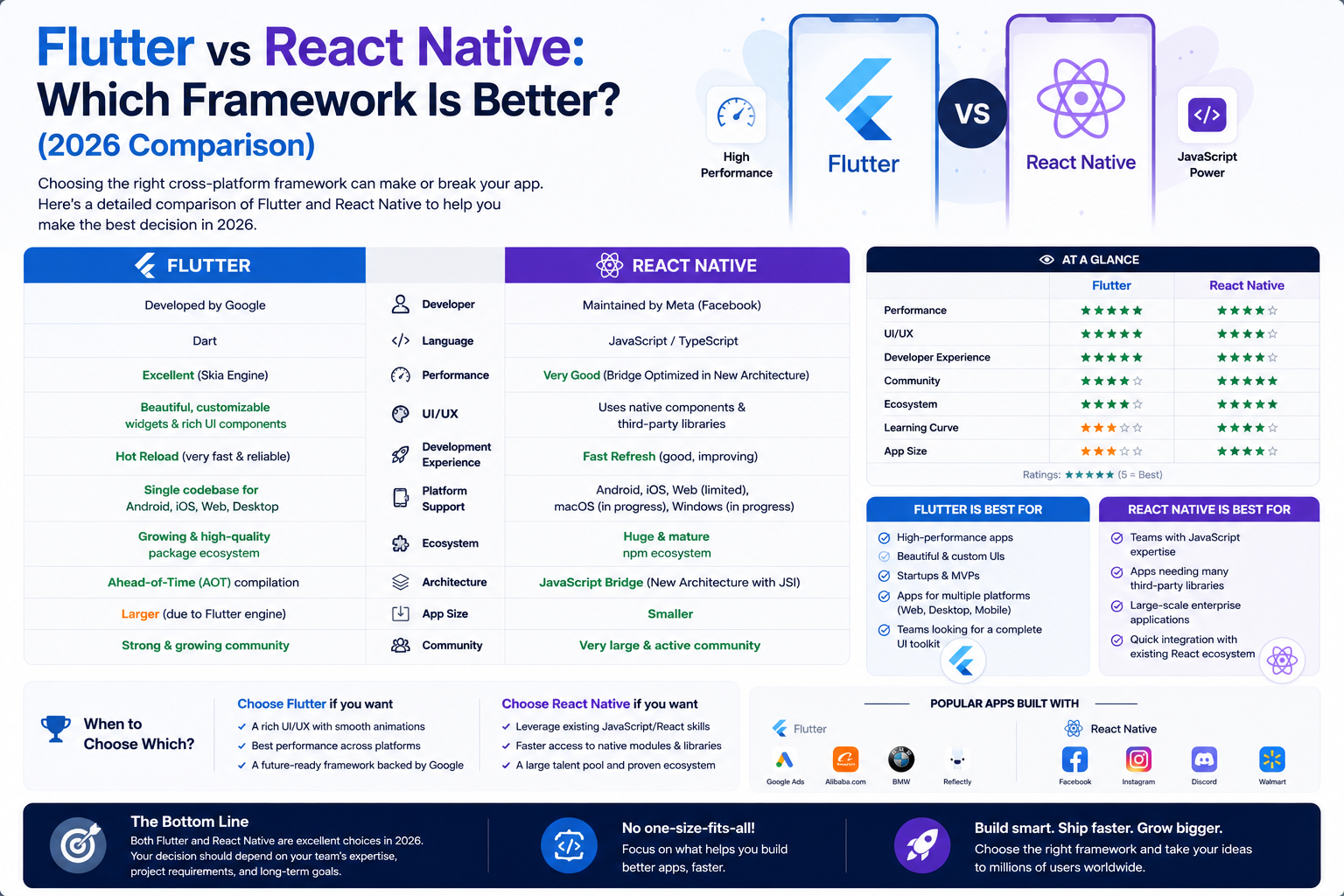

Compare Flutter vs React Native for cross-platform app development. Performance, developer experience, UI consistency, ecosystem, and which framework is right for your mobile app project.
Flutter vs React Native: Which Framework Is Better? (2026 Comparison)
Choosing the right cross-platform framework can save your business significant time and money while delivering apps that look and feel native on both Android and iOS. The two leading frameworks — Flutter (by Google) and React Native (by Meta/Facebook) — dominate the cross-platform development landscape.
What Is Flutter?
Flutter is Google's open-source UI toolkit for building natively compiled applications from a single codebase. It uses the Dart programming language and renders its own widgets rather than relying on platform UI components. Used by Google Pay, Alibaba, BMW, and eBay.
Key strengths: Exceptional performance with compiled native code, beautiful and consistent UI across platforms, hot reload for instant development feedback, comprehensive widget library, excellent documentation, strong Google backing.
What Is React Native?
React Native is Meta's framework for building mobile apps using JavaScript and React. It bridges JavaScript code to native platform components. Used by Facebook, Instagram, Shopify, Discord, and Bloomberg.
Key strengths: Large JavaScript developer community, code sharing with web React projects, mature ecosystem with extensive third-party libraries, hot reload, familiar React patterns for web developers.
Performance Comparison
| Aspect | Flutter | React Native |
|---|---|---|
| Rendering | Compiled to native ARM code | JavaScript bridge to native components |
| Animation Performance | Excellent (60fps smooth) | Good (can have bridge bottlenecks) |
| App Size | Slightly larger | Smaller base size |
| Startup Time | Fast | Slightly slower (JS engine init) |
| Memory Usage | Moderate | Moderate to high |
Winner: Flutter. Flutter's compiled native code and direct rendering give it a performance edge, especially for animation-heavy and graphically intensive apps. React Native's JavaScript bridge can introduce latency for complex operations, though the new React Native architecture (Fabric) significantly improves this.
Developer Experience
Flutter offers excellent documentation, a comprehensive widget library, built-in testing framework, strong IDE support (VS Code, Android Studio), and Dart — a language that is easy to learn but less widely known than JavaScript.
React Native benefits from the massive JavaScript ecosystem, familiar React patterns, hot reload, and easy onboarding for web React developers. However, debugging bridge issues and native module integration can be challenging.
UI Consistency
Flutter renders its own widgets, ensuring pixel-perfect identical UI across Android and iOS. This is ideal for brands wanting a consistent look everywhere. React Native uses native platform components, meaning your app looks native on each platform but may have subtle visual differences. This suits apps that want to feel like a natural part of each platform.
Third-Party Libraries and Ecosystem
React Native has a larger, more mature ecosystem with thousands of third-party libraries — a benefit of its longer history and JavaScript popularity. Flutter's ecosystem is growing rapidly and already covers most common needs. For cutting-edge features, both frameworks sometimes require native platform code.
Community and Job Market
React Native has a larger developer community due to JavaScript's popularity. More React Native developers are available in the job market. Flutter's community is growing faster and has very high developer satisfaction ratings. Finding Flutter developers is becoming easier as adoption increases.
Which Should You Choose?
Choose Flutter if: Performance and smooth animations are critical. You want pixel-perfect identical UI across platforms. You are building a new app without existing React Native code. You want the fastest time-to-market with the best developer experience.
Choose React Native if: Your team already knows React and JavaScript. You want to share code with an existing React web application. You need access to a specific library that exists only in the React Native ecosystem. You prefer native-looking UI that follows each platform's design guidelines.
Why Choose RedGobble?
At RedGobble, we build high-performance digital products for startups, businesses, and enterprises. Our expertise includes custom website development, AI solutions, AI agent development, SaaS platforms, ERP and CRM systems, mobile app development, business automation, UI/UX design, SEO-friendly websites, and cloud deployment.
Based in Greater Noida, Uttar Pradesh, India, RedGobble provides custom software development, AI solutions, mobile app development, and web development services for businesses across India and worldwide.
Frequently Asked Questions
Is Flutter better than React Native?
For most new apps, Flutter offers better performance, developer experience, and UI consistency. React Native is better for teams with existing React expertise or when code sharing with a React web app is needed.
Which framework do big companies use?
Flutter is used by Google Pay, Alibaba, BMW, and eBay. React Native is used by Facebook, Instagram, Shopify, and Discord. Both are production-proven.
Is Flutter good for complex apps?
Yes. Flutter handles complex UIs, animations, and business logic well. Its compiled nature gives it an advantage for computationally intensive apps.
Can I migrate from React Native to Flutter?
Yes, but it requires a complete rewrite as the frameworks are fundamentally different. The migration is worth it if you need better performance or UI consistency.
Which has better job prospects?
Both have strong demand. React Native has more positions due to JavaScript ecosystem. Flutter is growing faster and often commands higher rates.
Does Flutter support web and desktop?
Yes. Flutter supports iOS, Android, web, Windows, macOS, and Linux from a single codebase — a significant advantage over React Native.
Which is easier to learn?
React Native is easier for developers who already know React and JavaScript. Flutter is straightforward for anyone willing to learn Dart, with excellent documentation.
Conclusion
Both Flutter and React Native are excellent frameworks capable of building production-quality cross-platform apps. Flutter leads in performance, UI consistency, and developer experience. React Native leads in ecosystem maturity and JavaScript familiarity. For most new projects, Flutter is our recommended choice — it delivers better results faster and with fewer compromises.
Ready to start your project? [Book a Free Consultation](/contact) with the RedGobble team today.