How Long Does It Take to Build a Custom Website? (2026 Timeline Guide)
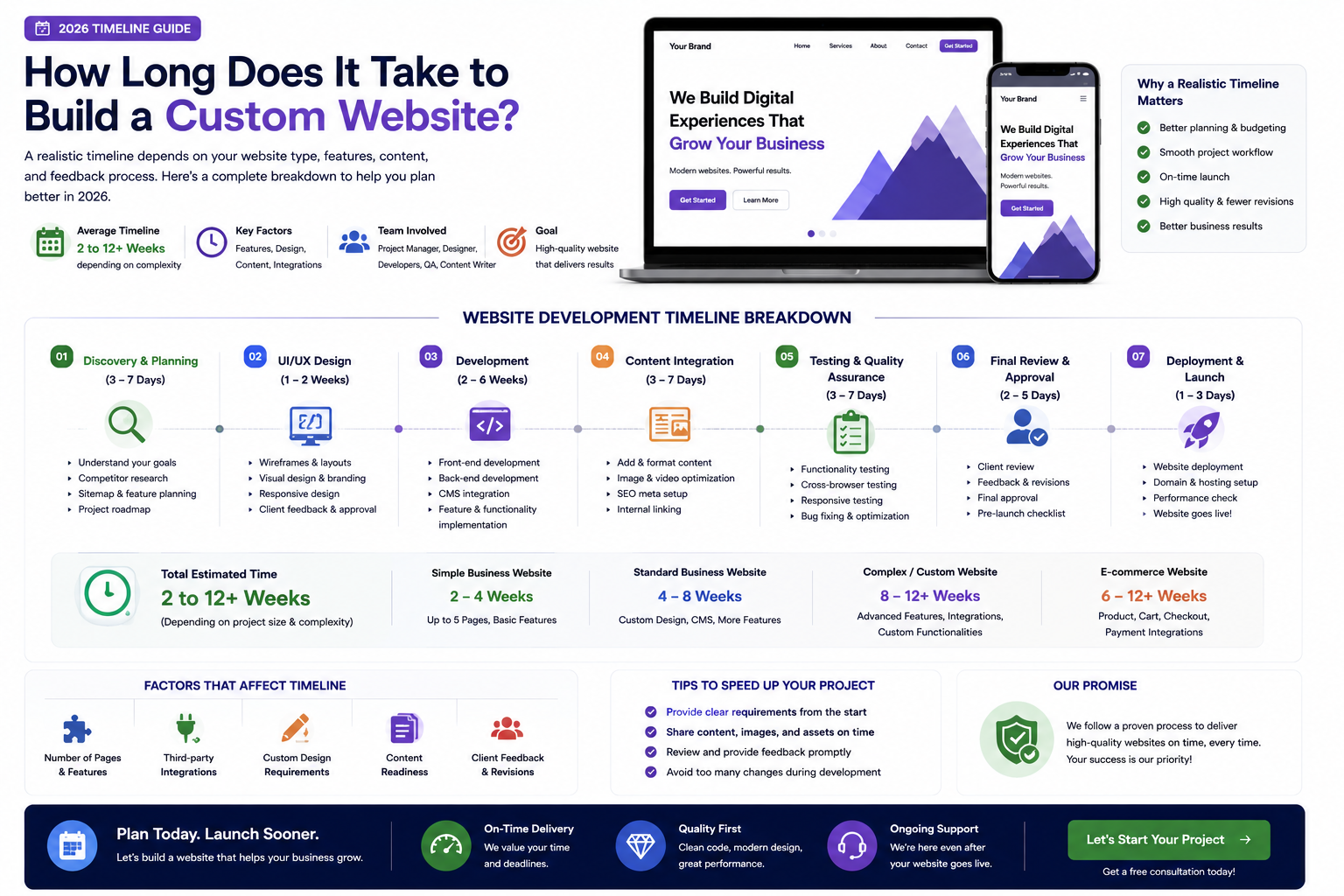

Discover realistic timelines for building custom websites, from landing pages to enterprise platforms. Learn what factors affect development duration and how to speed up your project.
How Long Does It Take to Build a Custom Website? (2026 Timeline Guide)
One of the most common questions businesses ask when planning a website project is: "How long will it take?" The answer depends on multiple factors — project complexity, number of pages, custom features, integrations, and the development team's experience. A simple landing page can be ready in 1-2 weeks, while a complex SaaS platform or enterprise web application may take 6-12 months or more. Understanding realistic timelines helps you plan your launch, allocate resources, and set proper expectations.
Website Development Timeline by Type
| Website Type | Estimated Timeline | Example |
|---|---|---|
| Landing Page | 1-2 weeks | Product launch page, event registration |
| Simple Business Website | 2-4 weeks | 5-page site with contact form, basic SEO |
| Professional Business Website | 4-8 weeks | 10-20 pages, CMS, blog, SEO, analytics |
| E-commerce Website | 8-16 weeks | Product catalog, cart, payments, admin panel |
| Custom Web Application | 8-24 weeks | Dashboards, user portals, complex integrations |
| Enterprise Platform | 12-40 weeks | ERP, CRM, multi-user, advanced workflows |
| SaaS Product | 12-52 weeks | Multi-tenant, subscriptions, billing, APIs |
Factors That Affect Development Timeline
1. Project Complexity. A simple informational website with a few pages takes far less time than a web application with user authentication, dashboards, payment processing, and third-party integrations. Every custom feature adds development, testing, and debugging time.
2. Number of Pages and Templates. Each unique page layout requires design and development time. A website with 5 page templates takes less time than one with 20 unique layouts. Using a consistent design system across pages can reduce overall timeline.
3. Design Requirements. Custom UI/UX design with research, wireframes, prototypes, animations, and multiple revision rounds adds weeks to the timeline. Template-based designs reduce design time but may compromise brand uniqueness.
4. Custom Features and Integrations. Integrating payment gateways, CRM systems, ERP software, AI chatbots, booking systems, membership portals, and third-party APIs requires additional development and thorough testing. Each integration must be tested for security, performance, and edge cases.
5. Content Readiness. If all content — text, images, videos, product descriptions — is ready before development starts, the project moves faster. Content delays are one of the most common causes of missed deadlines in website projects.
6. Technology Stack. Modern frameworks like Next.js and React enable faster development with reusable components, server-side rendering, and built-in optimizations. Using outdated or inappropriate technology can significantly slow down development.
7. Team Size and Experience. A skilled team of designers, developers, QA engineers, and project managers working together can deliver faster than a solo freelancer. Experienced teams anticipate challenges and follow efficient workflows.
8. Feedback and Revision Cycles. The speed of client feedback directly impacts the timeline. Prompt, clear feedback keeps the project moving. Delayed or unclear feedback creates bottlenecks. Structured review cycles with specific deadlines help everyone stay on track.
Phase-by-Phase Timeline Breakdown
Discovery and Planning (1-2 weeks): Requirements gathering, competitor analysis, technology selection, project scope document, timeline creation, and budget finalization. UI/UX Design (1-4 weeks): Wireframes, interactive prototypes, high-fidelity UI mockups, mobile responsive designs, design system creation, and client review and approval. Content Creation (1-3 weeks, can overlap with design): SEO keyword research, page content writing, image and media preparation, CTA copywriting, and metadata creation. Frontend Development (2-8 weeks): Converting designs to code, building responsive layouts, implementing animations and interactions, integrating with backend APIs, and optimizing for performance. Backend Development (2-12 weeks, if needed): Database design and setup, API development, authentication systems, business logic implementation, third-party integrations, and admin panel development. Testing and QA (1-4 weeks): Functional testing of all features, cross-browser testing, mobile responsiveness testing, performance and speed testing, security testing, accessibility testing, and user acceptance testing. Launch and Deployment (3-7 days): Server configuration, domain and DNS setup, SSL installation, analytics setup, final content review, search engine submission, and go-live.
Tips to Speed Up Website Development
Prepare content in advance — have all text, images, and product information ready before development starts. Provide clear requirements — detailed specifications reduce misunderstandings and revisions. Give timely feedback — quick, constructive feedback during design and development phases prevents bottlenecks. Limit scope creep — stick to the agreed scope initially; add new features in later phases after launch. Choose the right technology — modern frameworks like Next.js accelerate development with built-in optimizations. Work with an experienced team — professionals anticipate challenges, reuse proven components, and follow efficient workflows.
Why Choose RedGobble?
At RedGobble, we build high-performance digital products for startups, businesses, and enterprises. Our expertise includes custom website development, AI solutions, AI agent development, SaaS platforms, ERP and CRM systems, mobile app development, business automation, UI/UX design, SEO-friendly websites, and cloud deployment.
Based in Greater Noida, Uttar Pradesh, India, RedGobble provides custom software development, AI solutions, mobile app development, and web development services for businesses across India and worldwide.
Frequently Asked Questions
How long does a 5-page business website take?
A professional 5-page business website typically takes 2-4 weeks from planning to launch, assuming content is ready and feedback is timely.
How long does an e-commerce website take to build?
E-commerce websites usually take 8-16 weeks, depending on the number of products, payment gateway integrations, and custom features like inventory management.
Can a website be built in one week?
A simple landing page or single-page website can be built in 1-2 weeks. However, multi-page business websites with custom design, SEO, and CMS require more time for quality results.
What can delay a website project?
Common delays include late content submission, slow client feedback, scope changes mid-project, unexpected technical challenges, and third-party API integration issues.
How can I speed up my website development?
Prepare all content in advance, provide clear and timely feedback, avoid scope creep, and work with an experienced development team using modern technology.
Is it possible to launch faster by reducing testing?
We strongly advise against reducing testing. Thorough testing prevents bugs, security vulnerabilities, and performance issues that could damage your brand and require expensive fixes after launch.
What happens after the website launches?
Post-launch, we provide ongoing maintenance, security updates, performance monitoring, and feature enhancements. A website needs continuous care to remain secure and competitive.
Do you use templates to build websites faster?
No. We build fully custom websites from scratch. While templates can reduce timeline, they compromise uniqueness, performance, and long-term scalability.
How long does a website redesign take compared to a new build?
A redesign typically takes 60-80% of the time of a new build, as existing content, structure, and brand assets can be leveraged.
What is the minimum time needed for a professional business website?
We recommend budgeting at least 3-4 weeks for a professional business website to ensure proper planning, quality design, thorough development, and comprehensive testing.
Conclusion
Website development timelines vary significantly based on project complexity, features, and team capability. The most important factors you can control are content readiness, timely feedback, and choosing the right development partner. Investing adequate time upfront in planning and design pays dividends later — projects that skip these phases inevitably face delays, cost overruns, and disappointing results.
Ready to start your project? [Book a Free Consultation](/contact) with the RedGobble team today.