SEO Checklist for Business Websites (2026 Complete Guide)
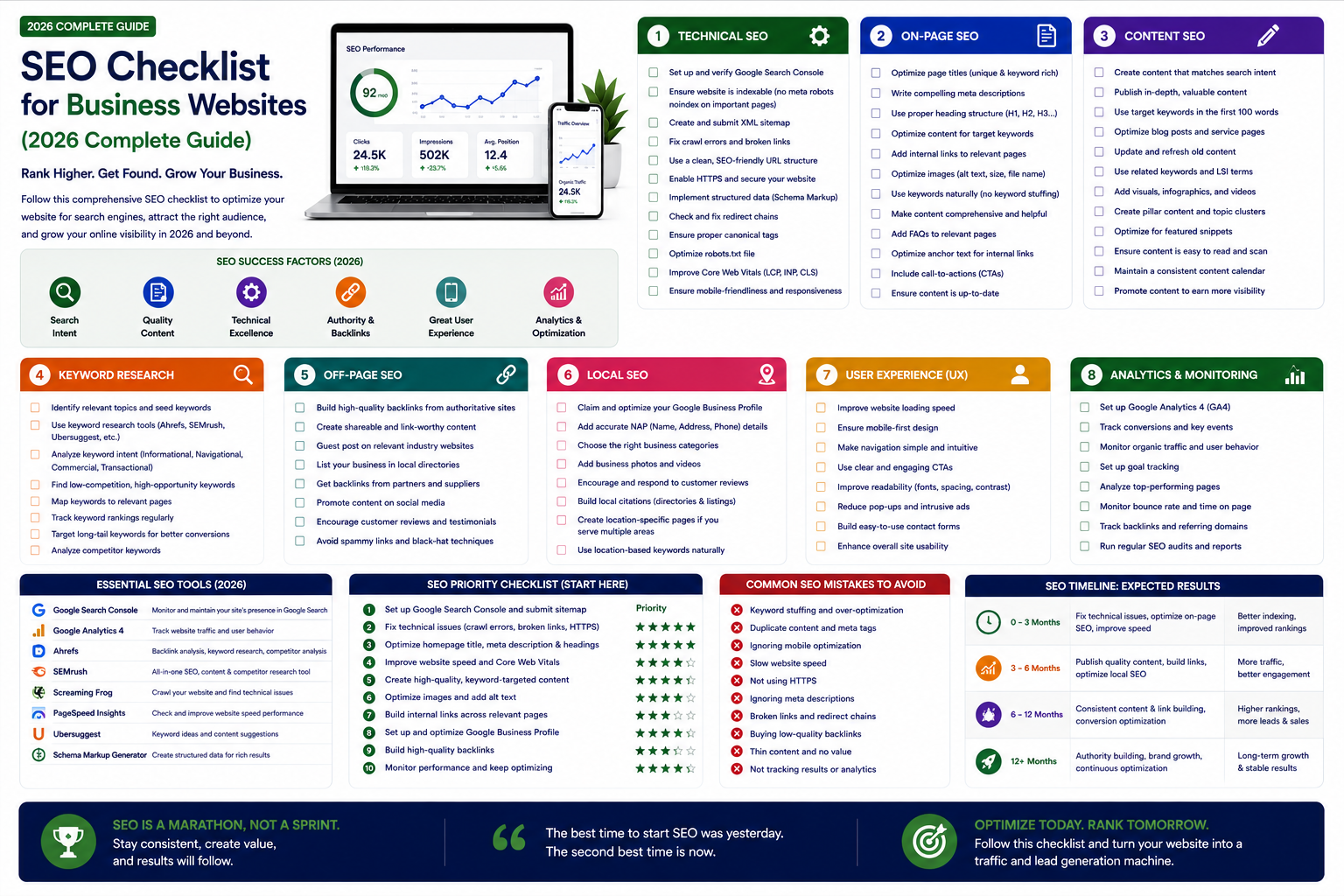

A comprehensive SEO checklist covering technical SEO, on-page optimization, content strategy, off-page SEO, and monitoring. Follow these steps to improve your Google rankings and organic traffic.
SEO Checklist for Business Websites (2026 Complete Guide)
Search Engine Optimization (SEO) is the single most cost-effective way to attract qualified visitors to your business website. Unlike paid advertising, which stops generating traffic the moment you stop paying, SEO builds lasting visibility that compounds over time. This comprehensive checklist covers every aspect of SEO your business website needs to rank higher on Google and attract more organic traffic.
Technical SEO Checklist
1. SSL Certificate Installed. Google prioritizes secure websites. Ensure your website loads over HTTPS with a valid SSL certificate. Check for mixed content issues where some resources still load over HTTP.
2. XML Sitemap Created and Submitted. An XML sitemap helps search engines discover and index all your pages. Generate one automatically and submit it to Google Search Console and Bing Webmaster Tools.
3. Robots.txt Configured. This file tells search engines which pages to crawl and which to ignore. Ensure it does not accidentally block important pages.
4. Mobile-Friendly Design. Over 60% of searches happen on mobile devices. Google uses mobile-first indexing, meaning it primarily uses the mobile version of your website for ranking. Test with Google's Mobile-Friendly Test tool.
5. Fast Loading Speed. Page speed is a direct ranking factor. Optimize images, implement caching, minify code, use a CDN. Target Core Web Vitals scores in the green zone (LCP under 2.5s, FID under 100ms, CLS under 0.1).
6. Clean URL Structure. URLs should be descriptive, include target keywords, use hyphens to separate words, avoid unnecessary parameters, and be consistent across your website.
On-Page SEO Checklist
7. Optimized Title Tags. Every page needs a unique, descriptive title tag between 50-60 characters including your primary keyword near the beginning. Format: Primary Keyword - Brand Name.
8. Compelling Meta Descriptions. Write unique meta descriptions (150-160 characters) for every page. Include the primary keyword, clearly describe what the page offers, and add a call-to-action to encourage clicks.
9. Proper Heading Structure. Use one H1 per page (usually the page title). Use H2s for main sections, H3s for subsections. Include keywords naturally in headings where relevant. Maintain a logical hierarchy — never skip levels.
10. Keyword Optimization. Research target keywords for each page. Include the primary keyword in the title, first paragraph, at least one heading, the URL, and naturally throughout the content. Use related keywords and synonyms (LSI keywords). Avoid keyword stuffing — write for humans first.
11. Image Optimization. Use descriptive filenames (not IMG_001.jpg). Add alt text describing each image (include keywords naturally). Compress images for fast loading. Use responsive images with appropriate sizes.
12. Internal Linking. Link between related pages using descriptive anchor text. Create a logical site structure where important pages are easily reachable. Every important page should be accessible within 3 clicks from the homepage.
13. Schema Markup. Implement structured data (JSON-LD format) to help search engines understand your content. Essential schemas for business websites: Organization, LocalBusiness, WebPage, Article (for blog), BreadcrumbList, and FAQPage (where applicable).
Content SEO Checklist
14. High-Quality, Original Content. Create content that genuinely helps your audience. Cover topics comprehensively. Write in clear, accessible language. Avoid duplicate content — every page should offer unique value. Update older content regularly to keep it fresh and accurate.
15. Blog and Resource Center. Publish regular blog posts targeting long-tail keywords. Each post should be at least 1,500-2,000 words for competitive topics. Cover topics your target customers are actually searching for. Include data, examples, and actionable advice.
16. E-E-A-T Signals. Demonstrate Experience, Expertise, Authoritativeness, and Trustworthiness. Include author bios with credentials. Cite reputable sources. Display trust signals like testimonials, certifications, and awards. Keep your About page detailed and authentic.
Off-Page SEO Checklist
17. Quality Backlinks. Earn links from reputable websites in your industry. Create link-worthy content (original research, comprehensive guides, useful tools). Guest post on relevant industry blogs. Avoid buying links or participating in link schemes.
18. Google Business Profile. Claim and optimize your Google Business Profile. Ensure NAP (Name, Address, Phone) is consistent across the web. Add photos, services, business hours, and respond to reviews.
19. Social Media Presence. While social signals are not direct ranking factors, active social profiles drive traffic, increase brand visibility, and can earn backlinks. Share your content across relevant platforms.
Monitoring and Maintenance
20. Google Search Console. Verify your website in Search Console. Monitor performance reports for clicks, impressions, and average position. Check for crawl errors and fix them promptly. Submit sitemaps and individual URLs for indexing.
21. Google Analytics 4. Track organic traffic, user behavior, conversions, and bounce rate. Identify top-performing pages and underperforming ones. Use data to guide content and optimization decisions.
22. Regular SEO Audits. Conduct comprehensive audits quarterly. Check for broken links, missing metadata, duplicate content, crawling issues, and declining rankings. Address issues before they significantly impact your traffic.
Why Choose RedGobble?
At RedGobble, we build high-performance digital products for startups, businesses, and enterprises. Our expertise includes custom website development, AI solutions, AI agent development, SaaS platforms, ERP and CRM systems, mobile app development, business automation, UI/UX design, SEO-friendly websites, and cloud deployment. We build every website with SEO best practices baked in — not as an afterthought.
Based in Greater Noida, Uttar Pradesh, India, RedGobble provides custom software development, AI solutions, mobile app development, and web development services for businesses across India and worldwide.
Frequently Asked Questions
How long does SEO take to show results?
SEO is a long-term strategy. Initial improvements can appear in 3-6 months, but significant results typically take 6-12 months of consistent effort. Competitive keywords may take longer.
Is SEO worth it for small businesses?
Yes. Local SEO especially can drive highly qualified leads at a fraction of the cost of paid advertising. A well-optimized website continues generating traffic and leads for years.
What is the most important SEO factor?
There is no single most important factor. Google uses over 200 ranking signals. However, high-quality content and quality backlinks consistently rank among the most impactful.
How often should I update my website content?
Review and update key pages quarterly. Blog posts should be published consistently — whether weekly, bi-weekly, or monthly. Update older posts when information becomes outdated.
Can I do SEO myself or should I hire an expert?
Basic on-page SEO is manageable for most business owners. Technical SEO, link building, and comprehensive strategy benefit from professional expertise.
Does social media help SEO?
Social media does not directly influence rankings, but it amplifies content reach, drives traffic, and can earn natural backlinks — all of which indirectly support SEO.
How does Next.js help with SEO?
Next.js provides server-side rendering and static generation, which ensures search engines can fully crawl and index your content. Built-in performance optimizations also improve Core Web Vitals scores.
What is schema markup and do I need it?
Schema markup is structured data that helps search engines understand your content. It can enable rich results like star ratings, FAQs, and breadcrumbs in search listings, improving click-through rates.
Conclusion
SEO is not a one-time task — it is an ongoing process that requires consistent effort and adaptation as algorithms evolve. By following this checklist, you build a strong foundation that will drive organic traffic, generate leads, and grow your business for years to come.
Ready to start your project? [Book a Free Consultation](/contact) with the RedGobble team today.