Shopify vs Custom E-commerce Website (2026 Comparison)
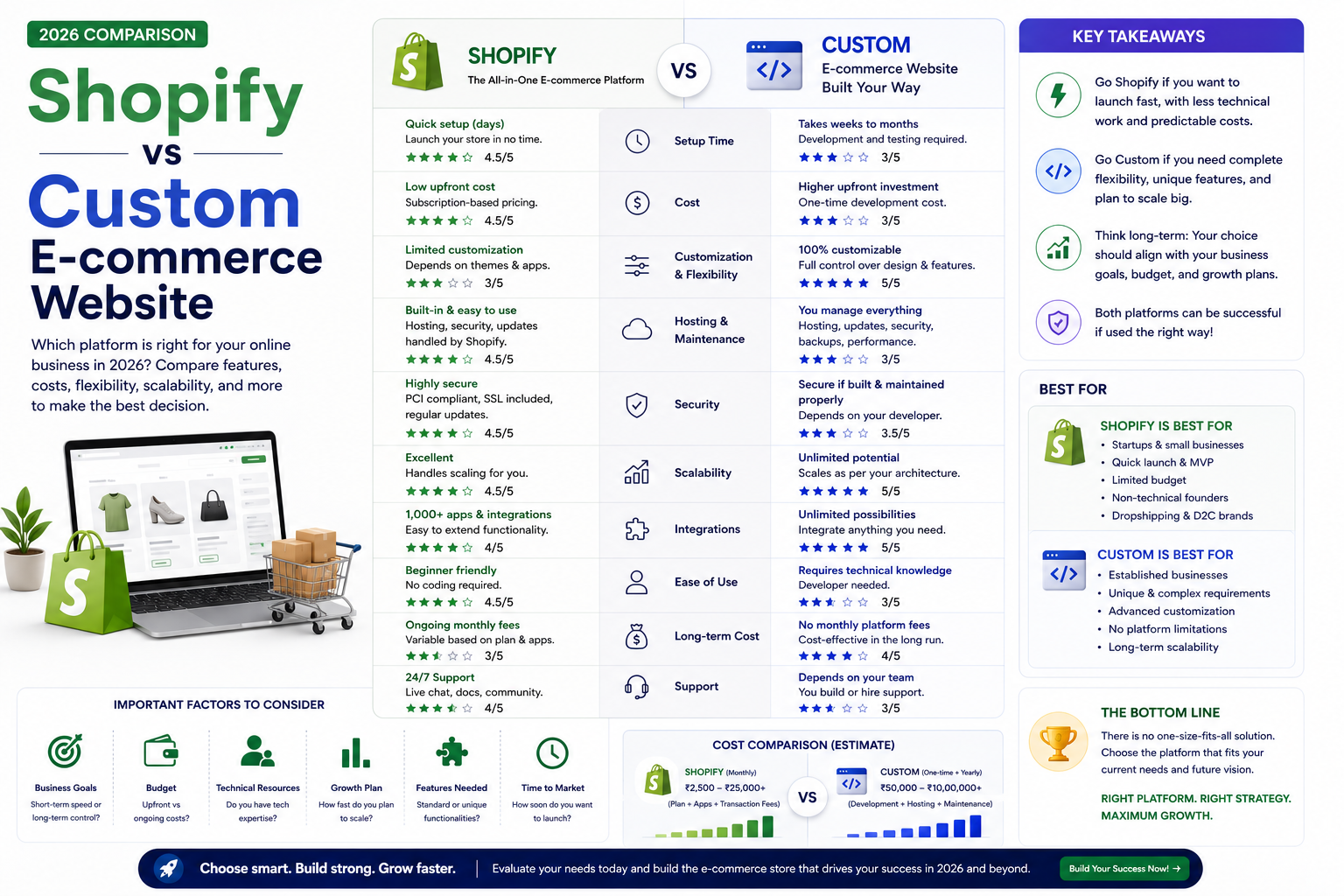

Compare Shopify vs custom e-commerce development. Understand costs, flexibility, scalability, ownership, and which option is best for your online store in 2026.
Shopify vs Custom E-commerce Website (2026 Comparison)
Shopify powers millions of online stores with its user-friendly platform. Custom e-commerce development offers unlimited flexibility and complete ownership. Which is right for your business?
Shopify Overview
Shopify is a hosted e-commerce platform where you pay a monthly subscription for the infrastructure, admin panel, themes, and app ecosystem. It handles hosting, security, and updates automatically.
Pros: Fast setup — launch in days with pre-built themes. No technical maintenance — Shopify handles updates and security. Large app ecosystem for additional features. Reliable hosting with excellent uptime. 24/7 support.
Cons: Monthly fees (Rs 1,500-20,000+). Transaction fees (2-3% unless using Shopify Payments). Limited customization — you work within Shopify's constraints. Vendor lock-in — migrating away is complex. You rent the platform, you do not own it.
Custom E-commerce Overview
Custom e-commerce is built from scratch (or with frameworks like Next.js) to your exact specifications. You own the code, control the infrastructure, and have unlimited flexibility.
Pros: Complete design freedom — anything you can imagine. No platform transaction fees — only payment gateway fees. Full ownership of code and data. Unlimited scalability. Deep custom integrations with any system. Unique features competitors cannot replicate.
Cons: Higher initial investment. Longer development timeline. You manage hosting and maintenance (or pay for managed services). Requires professional development team.
Cost Comparison Over 5 Years
| Cost Factor | Shopify | Custom E-commerce |
|---|---|---|
| Initial Setup | Rs 30,000 - Rs 3,00,000 | Rs 2,00,000 - Rs 10,00,000 |
| Monthly Platform Fees | Rs 1,500 - Rs 20,000+ | Rs 500 - Rs 10,000 (hosting) |
| Transaction Fees | 2-3% per sale | Payment gateway only (~2%) |
| Apps/Plugins | $10-$100+/month each | One-time integration cost |
| Maintenance | Included | Rs 5,000-Rs 50,000/month |
| 5-Year Total (Mid-size store) | Rs 3,00,000 - Rs 10,00,000+ | Rs 3,00,000 - Rs 15,00,000+ |
Custom e-commerce often becomes more cost-effective at higher volumes due to eliminated transaction fees.
Which Should You Choose?
Choose Shopify if: You need to launch quickly, have standard e-commerce requirements, prefer predictable monthly costs, do not want technical maintenance, or are testing a product idea with minimal upfront investment.
Choose custom if: You need unique features or workflows, want complete design control, do high sales volume (transaction fees add up), plan to scale significantly, need deep integrations with custom systems, or want to own your platform rather than rent it.
Why Choose RedGobble?
At RedGobble, we build high-performance digital products for startups, businesses, and enterprises. Our expertise includes custom website development, AI solutions, AI agent development, SaaS platforms, ERP and CRM systems, mobile app development, business automation, UI/UX design, SEO-friendly websites, and cloud deployment.
Based in Greater Noida, Uttar Pradesh, India, RedGobble provides custom software development, AI solutions, mobile app development, and web development services for businesses across India and worldwide.
Frequently Asked Questions
Is Shopify or custom e-commerce cheaper?
Shopify is cheaper initially. Custom e-commerce is often cheaper over 3-5 years for high-volume stores because there are no platform transaction fees.
Can I migrate from Shopify to custom later?
Yes, but it requires a complete rebuild. This is worth it when transaction fees exceed what custom hosting and maintenance would cost.
Which is better for SEO?
Custom e-commerce built with Next.js provides superior technical SEO — faster loading, better Core Web Vitals, and complete control over every SEO element. Shopify is good but limited.
Which scales better?
Custom e-commerce scales without platform limitations. Shopify scales well for most stores but can become expensive at very high volumes.
How long does migration take?
Shopify to custom migration typically takes 8-16 weeks including design, development, data migration, and SEO preservation.
Conclusion
Both Shopify and custom e-commerce are viable options in 2026. The right choice depends on your specific needs, growth plans, and whether you prioritize speed-to-market or long-term flexibility and ownership.
Ready to start your project? [Book a Free Consultation](/contact) with the RedGobble team today.