Website Development Process Explained: From Idea to Launch (2026 Complete Guide)
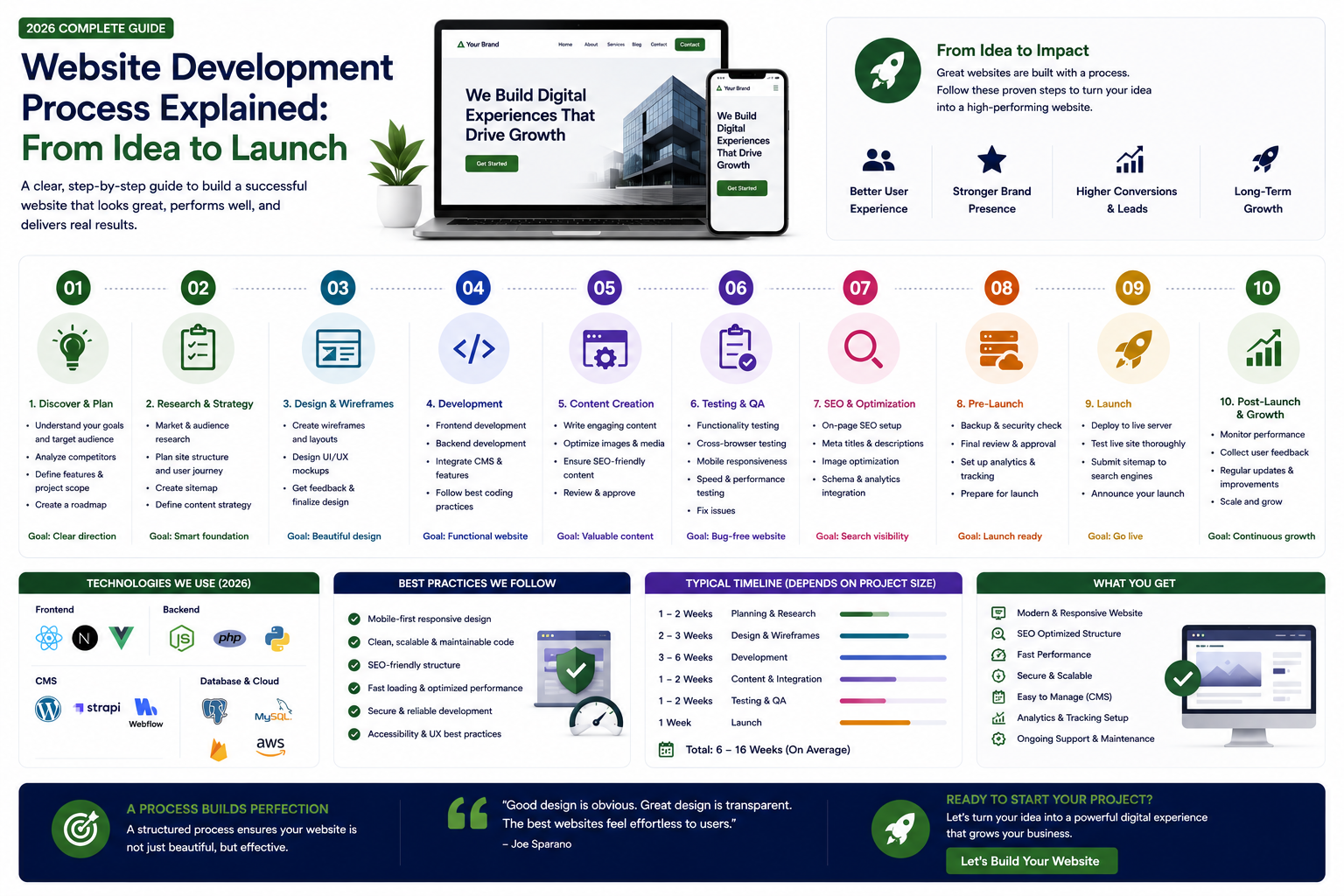

Learn the complete website development process from discovery and planning to UI/UX design, development, testing, launch, and post-launch maintenance. A step-by-step guide for businesses.
Website Development Process Explained: From Idea to Launch (2026 Complete Guide)
Building a website involves more than just writing code. Whether you are launching a business website, an e-commerce platform, a SaaS product, or a corporate portal, following a structured development process ensures your project stays on time, within budget, and delivers exactly what your business needs.
The website development process consists of seven key phases: Discovery and Planning, UI/UX Design, Content Strategy, Development, Testing and QA, Launch and Deployment, and Post-Launch Maintenance. Skipping any phase can lead to delays, budget overruns, or a website that fails to meet your business goals.
Phase 1: Discovery and Planning
Before writing a single line of code, you need a clear roadmap. This phase involves understanding business goals, identifying target audience, analyzing competitors, defining key features, selecting the right technology stack, creating project scope documentation, and establishing timelines and milestones. Key deliverables include a project scope document, competitor analysis report, technology recommendation, timeline with milestones, and budget breakdown. A thorough discovery phase prevents scope creep and misaligned expectations later in the project.
Phase 2: UI/UX Design
Once the plan is clear, the design team creates the visual experience. This phase includes wireframing — creating low-fidelity layouts showing page structure and user flow. Next comes prototyping — building interactive clickable prototypes to test navigation and user journeys. Finally, high-fidelity UI design delivers pixel-perfect mockups showing exact colors, typography, spacing, animations, and visual elements. The design should be responsive for mobile, tablet, and desktop, accessible for all users including those with disabilities, conversion-focused to guide visitors toward desired actions, and aligned with your brand identity and guidelines.
Phase 3: Content Strategy
Great design needs great content. Content strategy involves planning what each page needs, writing SEO-optimized copy with target keywords, creating high-quality images and videos, developing conversion-focused CTAs, and planning blog and resource sections for ongoing SEO. Best practices: Write for humans first, optimize for search engines second. Every page should have a clear purpose. Use headings to structure content logically. Include internal links between related pages.
Phase 4: Development
This is where the website comes to life. Frontend development uses technologies like Next.js, React, TypeScript. Backend development involves server setup, databases (PostgreSQL, Supabase), APIs, authentication, and business logic. Integration work connects payment gateways, CRM systems, email services, AI chatbots, analytics, and third-party APIs. Recommended modern tech stack: Next.js for the frontend framework (excellent SEO, fast performance), Node.js for backend APIs, PostgreSQL or Supabase for databases, and Vercel or AWS for hosting and deployment.
Phase 5: Testing and Quality Assurance
Before launching, every website needs thorough testing. Categories include functionality testing — do all features work correctly, including forms and authentication? Responsiveness testing — does the website display correctly on all devices from smartphones to large desktop monitors? Browser testing — does it work on Chrome, Safari, Firefox, and Edge? Performance testing checks page load speeds and Core Web Vitals. Security testing validates SSL, form security, authentication, and data protection. Accessibility testing ensures WCAG compliance. User acceptance testing lets real users test before the public launch.
Phase 6: Launch and Deployment
Launch day requires careful execution. Tasks include setting up the production server, configuring domain and DNS, installing SSL certificates, setting up Google Analytics 4 and Google Search Console, submitting XML sitemap to search engines, configuring backups and monitoring, and conducting a final review. Launch checklist: Domain connected and working, SSL certificate active, all forms working, analytics tracking correctly, sitemap submitted, robots.txt configured, 404 page customized, loading speed optimized, all content proofread.
Phase 7: Post-Launch Maintenance
Ongoing care includes regular security updates and patches, performance monitoring and optimization, content updates and blog publishing, SEO monitoring and improvement, backup management, feature enhancements based on user feedback, and analytics review and conversion optimization.
Website Development Timeline
| Website Type | Estimated Timeline |
|---|---|
| Landing Page | 1-2 weeks |
| Business Website (5-10 pages) | 3-6 weeks |
| E-commerce Website | 6-12 weeks |
| Custom Web Application | 8-20 weeks |
| Enterprise Platform | 12-30 weeks |
| SaaS Product | 12-40 weeks |
Common Mistakes to Avoid
Skipping the planning phase leads to endless revisions. Ignoring mobile users — over 60% of web traffic comes from mobile devices. Forgetting SEO — a beautiful website is useless if nobody can find it on Google. Choosing outdated technology causes performance and security problems. No post-launch plan leaves your website vulnerable. Overloading with features — start with essential features and add more based on real user feedback.
Why Choose RedGobble?
At RedGobble, we build high-performance digital products for startups, businesses, and enterprises. Our expertise includes custom website development, AI solutions, AI agent development, SaaS platforms, ERP and CRM systems, mobile app development, business automation, UI/UX design, SEO-friendly websites, and cloud deployment.
Based in Greater Noida, Uttar Pradesh, India, RedGobble provides custom software development, AI solutions, mobile app development, and web development services for businesses across India and worldwide.
Frequently Asked Questions
What is the first step in website development?
Discovery and planning — understanding business goals, target audience, competitors, and feature requirements before any design or development begins.
How long does a typical business website take to build?
A standard 5-10 page business website usually takes 3-6 weeks from planning to launch. Complex web applications and enterprise platforms can take 8-30 weeks.
What technology stack do you recommend?
Next.js with React for frontend, Node.js for backend APIs, PostgreSQL or Supabase for databases, and Vercel or AWS for hosting. This modern stack delivers excellent performance, SEO, and scalability.
Do I need to provide content for my website?
You can provide your own content, or our team can help with professional content writing as part of the development process. We ensure all content is SEO-optimized.
What happens after my website launches?
We offer ongoing maintenance packages including security updates, performance monitoring, content updates, backups, and feature enhancements based on your evolving needs.
Can you redesign my existing website?
Yes. We specialize in website redesigns and can modernize your existing website with improved design, performance, SEO, and functionality while preserving your brand identity.
Do you provide training on how to manage the website?
Yes. We provide training and documentation so your team can manage content, blog posts, and basic updates without technical assistance.
How do you ensure the website is SEO-friendly?
Every website we build includes technical SEO — schema markup, optimized metadata, fast loading, mobile responsiveness, XML sitemap, clean URLs, and Core Web Vitals optimization.
What if I need changes after the project starts?
We use agile development practices that accommodate reasonable changes. Major scope changes are discussed transparently with timeline and budget adjustments if needed.
How involved do I need to be during development?
Your involvement is valuable during planning, design approval, and content review. Our project managers handle day-to-day coordination so you can focus on your business.
Conclusion
A well-structured website development process is the foundation of every successful digital project. By following the seven phases — discovery, design, content, development, testing, launch, and maintenance — you ensure your website meets business goals, delights users, and delivers measurable results.
Ready to start your project? [Book a Free Consultation](/contact) with the RedGobble team today.