Website Redesign Guide: When Should You Redesign Your Website? (2026 Complete Guide)
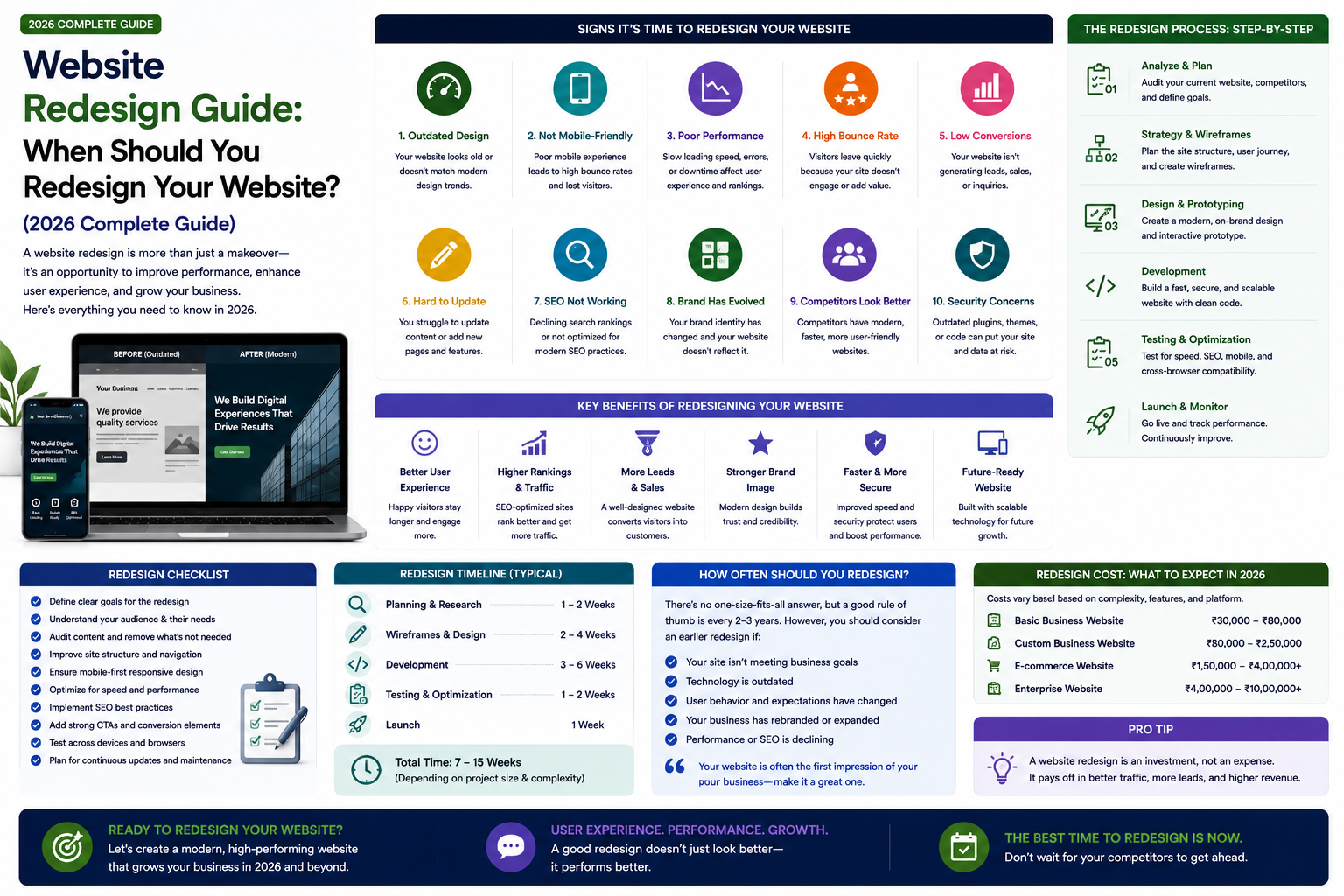

Learn when your business needs a website redesign, the redesign process, costs, common mistakes, and how to ensure your new website drives better results for your business.
Website Redesign Guide: When Should You Redesign Your Website? (2026 Complete Guide)
Your website is often the first interaction a potential customer has with your brand. If it feels outdated, loads slowly, or looks unprofessional on mobile devices, you are losing business — often without even knowing it. A website redesign is not just about changing colors and fonts — it is about realigning your digital presence with your current business goals, customer expectations, and technology standards.
Signs Your Website Needs a Redesign
1. It Looks Outdated. Design trends evolve rapidly. If your website looks like it was built five years ago, visitors question your professionalism and credibility. Modern websites feature clean layouts, bold typography, ample white space, subtle animations, and mobile-first design.
2. It Is Not Mobile Responsive. Over 60% of web traffic comes from mobile devices. If your website does not adapt perfectly to smartphones and tablets, you are frustrating most visitors. Google also prioritizes mobile-friendly websites in search rankings.
3. It Loads Slowly. Visitors expect websites to load in under three seconds. If your pages take longer, users leave and rarely return. Slow loading also hurts your Google rankings and conversion rates.
4. Your Business Has Evolved. New services, new markets, changed brand positioning, or new products. Your website should reflect your current business, not what you were doing three years ago.
5. It Is Not Generating Leads or Sales. If visitors are not converting into leads, calls, or customers, something is wrong with your messaging, UX, or CTAs. A redesign focused on conversion optimization can dramatically improve results.
6. It Is Difficult to Update. If you need a developer for every small content change, your website is holding your business back. Modern websites include content management systems that let your team manage content without technical knowledge.
7. It Does Not Rank on Google. If your target customers cannot find you on search engines, your website likely has SEO issues — poor structure, missing metadata, slow loading, or thin content.
8. Security Vulnerabilities. Older websites on outdated platforms with unmaintained plugins are vulnerable to hacking, malware, and data breaches. A redesign on a modern, secure platform protects your business and customers.
Website Redesign vs Website Refresh
| Aspect | Website Refresh | Website Redesign |
|---|---|---|
| Scope | Minor visual updates | Complete visual and structural change |
| Design | Update colors, fonts, images | New layouts, UX, branding |
| Functionality | No major changes | New features, integrations, CMS |
| Technology | Stays on same platform | May involve platform migration |
| Timeline | 1-3 weeks | 4-16 weeks |
| Cost | Lower | Higher |
The Website Redesign Process
Step 1: Audit Your Current Website. Analyze what is working and what is not. Review analytics data, user behavior, conversion rates, SEO performance, page speed, and content quality. Identify pages that perform well and pages that underperform.
Step 2: Define Goals for the Redesign. What should the new website accomplish? More leads, higher sales, better brand perception, improved SEO rankings, faster loading, easier content management. Clear goals guide every design and development decision.
Step 3: Plan Information Architecture. Reorganize content structure to match how users actually navigate. Simplify menus, group related content, remove outdated pages, and create clear user journeys that guide visitors toward conversion.
Step 4: Design the New Experience. Wireframes to plan layouts, interactive prototypes to test navigation, high-fidelity mockups showing final visual experience. Focus on mobile-first design, accessibility, brand consistency, and conversion optimization.
Step 5: Develop with Modern Technology. Rebuild using modern frameworks like Next.js for fast performance, excellent SEO, and easy scalability. Implement a CMS for self-service content management. Set up analytics, SEO foundations, and security measures.
Step 6: Content Migration and Optimization. Review, update, and rewrite existing content for the new design. Optimize for target keywords, add new content where needed, and ensure all pages have proper metadata, headings, and internal links.
Step 7: Testing and Launch. Thoroughly test every page, form, link, and feature across all devices and browsers. Set up 301 redirects from old URLs to new ones. Submit updated sitemap. Monitor analytics closely.
How Much Does a Website Redesign Cost?
| Redesign Type | Estimated Cost (India) |
|---|---|
| Small Business Website Refresh | Rs 15,000 - Rs 50,000 |
| Professional Business Website Redesign | Rs 50,000 - Rs 1,50,000 |
| E-commerce Website Redesign | Rs 80,000 - Rs 3,00,000 |
| Custom Web Application Redesign | Rs 1,50,000 - Rs 8,00,000+ |
| Enterprise Platform Redesign | Rs 3,00,000+ |
Common Website Redesign Mistakes
Changing everything at once can confuse existing customers. Ignoring SEO during migration destroys search rankings — always set up 301 redirects. Focusing only on visuals means a beautiful website that loads slowly and converts poorly. Not involving users — test your new design with real users before launching. No post-launch monitoring — watch analytics, search rankings, and user behavior carefully after launch to catch and fix issues quickly.
Why Choose RedGobble?
At RedGobble, we build high-performance digital products for startups, businesses, and enterprises. Our expertise includes custom website development, AI solutions, AI agent development, SaaS platforms, ERP and CRM systems, mobile app development, business automation, UI/UX design, SEO-friendly websites, and cloud deployment.
Based in Greater Noida, Uttar Pradesh, India, RedGobble provides custom software development, AI solutions, mobile app development, and web development services for businesses across India and worldwide.
Frequently Asked Questions
How do I know if my website needs a redesign?
If your website looks outdated, loads slowly, is not mobile-friendly, fails to generate leads, or does not rank on Google, it is time for a redesign. Most business websites benefit from a redesign every 2-4 years.
Will a redesign hurt my SEO rankings?
Not if done correctly. We implement 301 redirects from old URLs to new ones, preserve key content, maintain site structure, and submit updated sitemaps to protect and often improve search rankings.
How long does a website redesign take?
A business website redesign typically takes 4-12 weeks, depending on the number of pages, design complexity, and functionality requirements.
Can you redesign my website without changing my brand?
Absolutely. We modernize the design, improve functionality, and enhance performance while preserving your brand identity, colors, logo, and core messaging.
What is the difference between a redesign and a refresh?
A refresh makes minor visual updates like colors, fonts, and images. A redesign involves comprehensive changes to layout, UX, technology, functionality, and content structure.
Do I need new content for my redesigned website?
We review your existing content and recommend what to keep, update, rewrite, or remove. Our team can also create new SEO-optimized content if needed.
Should I switch technology platforms during a redesign?
If your current platform limits performance, security, or scalability, a redesign is the perfect time to migrate to modern technology like Next.js. We handle the migration seamlessly.
How much does a website redesign cost?
Professional business website redesigns in India typically range from Rs 50,000 to Rs 1,50,000. E-commerce and enterprise redesigns cost more due to complexity.
Will my website be down during the redesign?
No. We develop the new website in a staging environment. Your current website remains live until the new one is ready, tested, and approved for launch.
What ongoing support do you provide after redesign?
We offer maintenance packages covering security updates, performance monitoring, content updates, backups, and feature enhancements to keep your website performing at its best.
Conclusion
A website redesign is a strategic investment that can transform your digital presence. By identifying the signs that your website needs change, following a structured process, and partnering with an experienced team, you can achieve a website that drives real business results.
Ready to start your project? [Book a Free Consultation](/contact) with the RedGobble team today.