AI Chatbots vs AI Agents: What's the Difference? (2026 Guide)
Learn the key differences between AI chatbots and AI agents. Understand their capabilities, use cases, and which technology is right for your business automation needs.
AI Chatbots vs AI Agents: What's the Difference? (2026 Guide)
The terms AI chatbot and AI agent are often used interchangeably, but they represent fundamentally different technologies with distinct capabilities, use cases, and complexity levels. Understanding the difference helps you choose the right solution for your business.
What Is an AI Chatbot?
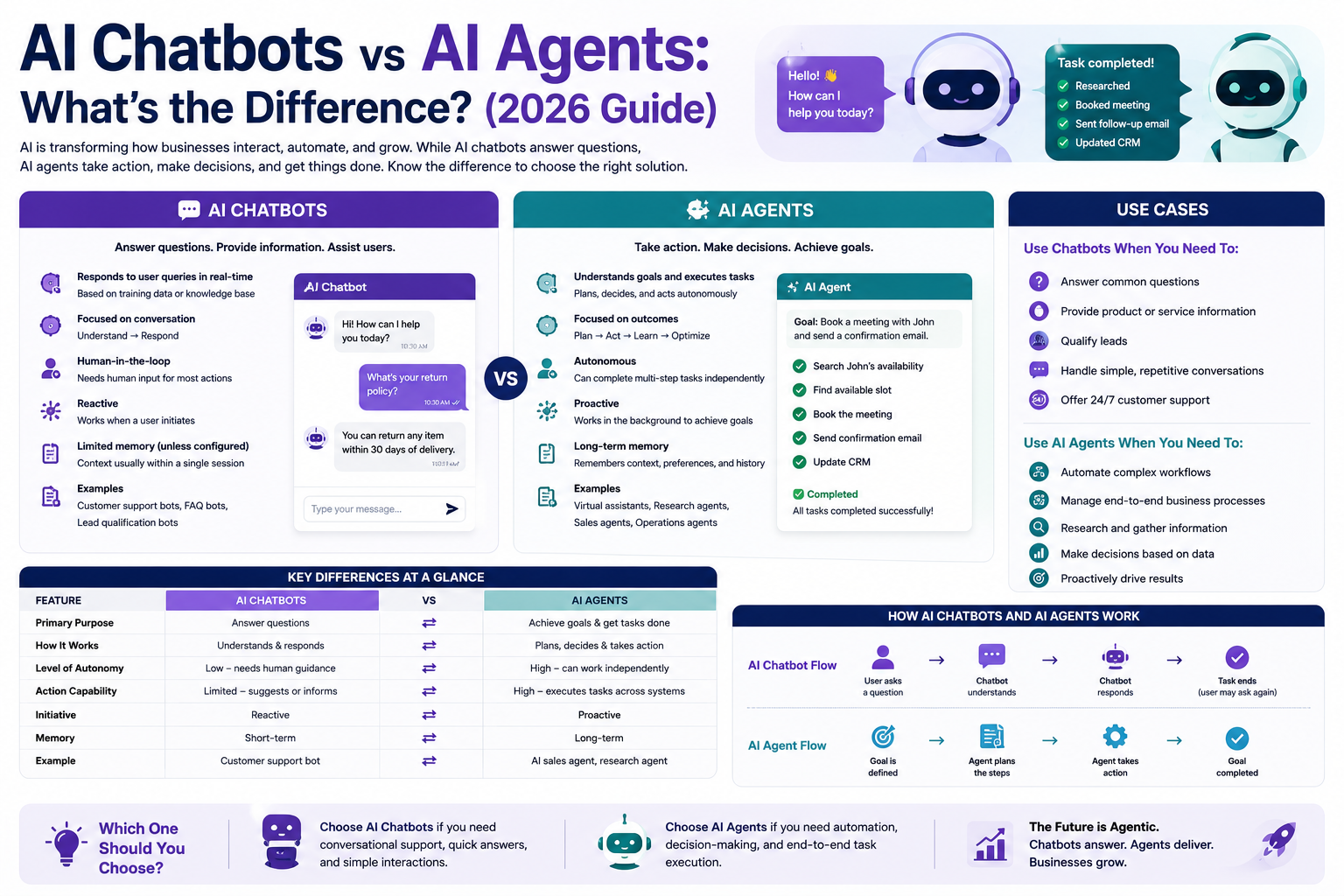
An AI chatbot is a conversational interface designed to interact with users through text or voice. It responds to queries, provides information, answers FAQs, and can perform simple tasks like booking appointments or capturing leads. Chatbots operate within defined boundaries — they follow conversation flows and respond based on their training and programming.
Key characteristics: Responds to user prompts and questions, operates within defined conversation flows, handles specific predictable tasks, typically text or voice-based interaction, and requires human escalation for complex issues.
What Is an AI Agent?
An AI agent is a more advanced autonomous system that can perceive its environment, make decisions, take actions, and learn from outcomes to achieve specific goals. Unlike chatbots that wait for user input, agents can proactively initiate actions, chain multiple tasks together, and operate independently.
Key characteristics: Autonomous — can act without waiting for user prompts. Goal-oriented — works toward achieving specific objectives. Can chain multiple actions together to complete complex workflows. Learns and adapts from outcomes and feedback. Can interact with multiple systems, APIs, and tools. Maintains context and state across extended periods.
Comparison Table
| Aspect | AI Chatbot | AI Agent |
|---|---|---|
| Autonomy | Reactive (responds to user) | Proactive (can initiate actions) |
| Task Complexity | Simple, single-step tasks | Complex, multi-step workflows |
| Decision Making | Follows predefined rules | Makes autonomous decisions |
| Learning | Limited or static | Continuous learning from outcomes |
| System Integration | Basic API calls | Deep multi-system integration |
| Memory | Session-based | Persistent across interactions |
| Use Cases | Customer support, FAQs, lead capture | Process automation, research, complex workflows |
When to Use an AI Chatbot
AI chatbots are ideal for customer support — answering FAQs, troubleshooting common issues, directing to resources. Lead generation — qualifying website visitors and capturing contact information. Appointment scheduling — checking availability and booking meetings. Basic information retrieval — looking up order status, account information, product details.
When to Use an AI Agent
AI agents are suited for process automation — autonomously managing multi-step business workflows. Research and analysis — gathering data from multiple sources, analyzing it, and presenting findings. Proactive monitoring — watching for specific conditions and taking action when triggered. Complex customer service — handling multi-step resolution processes across systems. Personal assistance — managing calendars, emails, and tasks proactively.
Why Choose RedGobble?
At RedGobble, we build high-performance digital products for startups, businesses, and enterprises. Our expertise includes custom website development, AI solutions, AI agent development, SaaS platforms, ERP and CRM systems, mobile app development, business automation, UI/UX design, SEO-friendly websites, and cloud deployment.
Based in Greater Noida, Uttar Pradesh, India, RedGobble provides custom software development, AI solutions, mobile app development, and web development services for businesses across India and worldwide.
Frequently Asked Questions
What is the main difference between an AI chatbot and an AI agent?
AI chatbots react to user prompts and handle simple, defined tasks. AI agents are autonomous, can proactively initiate actions, complete complex multi-step workflows, and learn from outcomes.
Which is better for customer support?
AI chatbots are excellent for frontline customer support — answering FAQs and handling common issues. AI agents can handle complex, multi-step support scenarios.
Can an AI chatbot become an AI agent?
Not exactly. While chatbots can be enhanced with more capabilities, true AI agents have fundamentally different architecture focused on autonomy and goal-orientation.
Are AI agents more expensive than chatbots?
Yes, typically. AI agents are more complex to build and maintain. However, they can automate higher-value, more complex tasks, potentially delivering greater ROI.
Does my business need an AI agent?
If you have complex, multi-step workflows that currently require significant human effort, an AI agent might be appropriate. For most customer-facing interactions, an AI chatbot provides excellent value at lower cost.
What technologies power AI agents?
Large Language Models (LLMs), reinforcement learning, tool-use frameworks, vector databases for memory, and multi-agent orchestration systems.
Can I use both chatbots and agents?
Yes. Many businesses use chatbots for customer-facing interactions and AI agents for internal process automation. The technologies complement each other.
Conclusion
Both AI chatbots and AI agents have their place in modern business. Chatbots excel at customer interaction and simple task automation. Agents shine in complex, multi-step workflows requiring autonomy. The right choice depends on your specific business challenges.
Ready to start your project? [Book a Free Consultation](/contact) with the RedGobble team today.