Digital Transformation Guide for Small Businesses (2026)
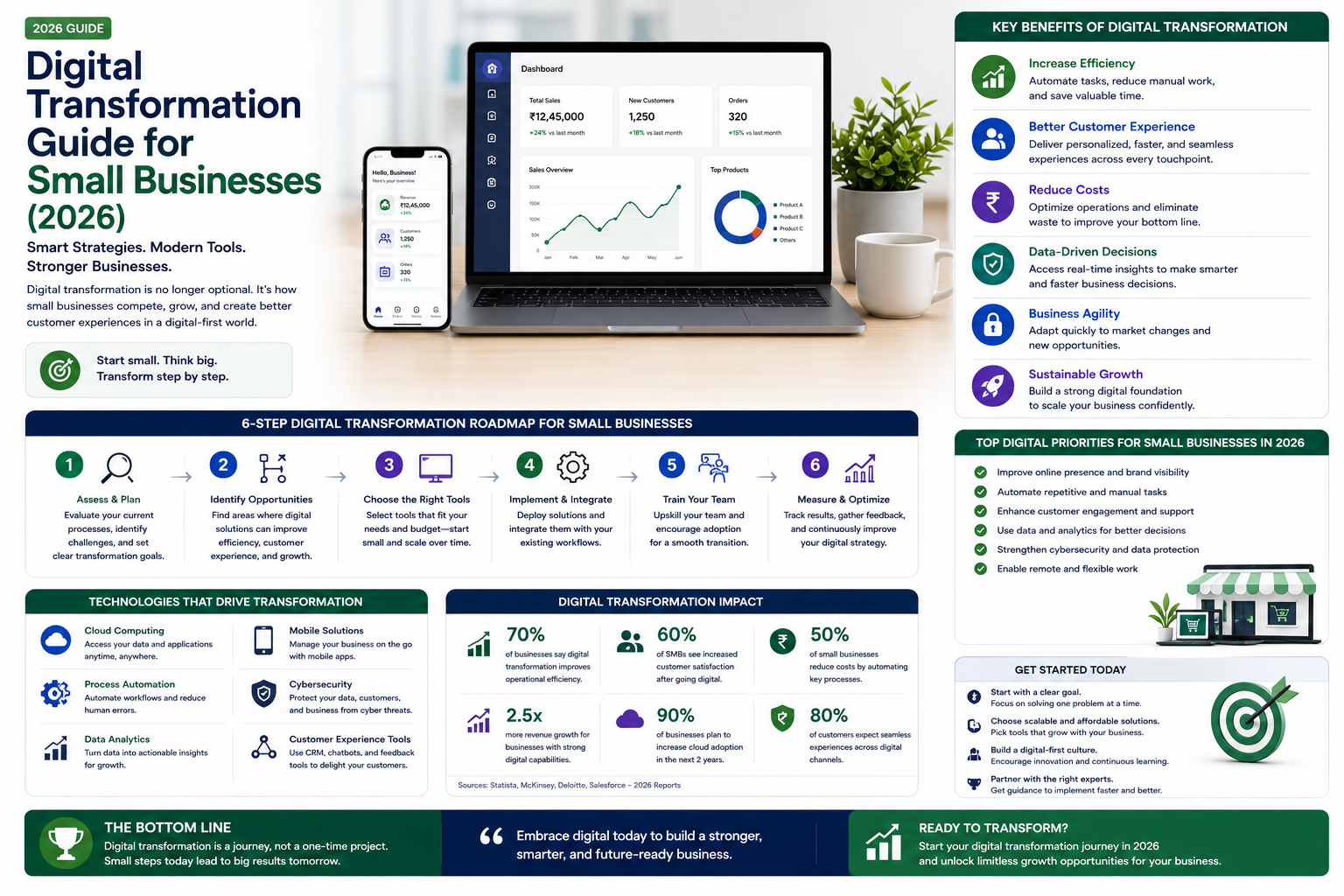

Complete guide to digital transformation for small businesses. Learn how to adopt digital tools, automate processes, and leverage technology to compete and grow in 2026.
Digital Transformation Guide for Small Businesses (2026)
Digital transformation is not just for enterprises. Small businesses that embrace digital tools and processes can compete effectively with larger competitors, serve customers better, and operate more efficiently. This guide covers what digital transformation means for small businesses and how to implement it successfully.
What Is Digital Transformation?
Digital transformation is the integration of digital technology into all areas of a business, fundamentally changing how you operate and deliver value to customers. It goes beyond simply buying software — it involves rethinking processes, culture, and customer experiences through a digital lens.
Why Digital Transformation Matters for Small Businesses
Small businesses face unique challenges — limited resources, small teams, and competition from larger, better-funded companies. Digital transformation levels the playing field. Cloud software provides enterprise-grade tools at small business prices. Automation handles repetitive work that would otherwise require additional staff. Digital marketing reaches targeted audiences more cost-effectively than traditional advertising. Data analytics provide insights previously available only to companies with dedicated analysts.
The Four Pillars of Digital Transformation
1. Technology Adoption. Move from manual processes and disconnected spreadsheets to integrated digital tools — cloud accounting, CRM, project management, communication platforms. The goal is not to have the most technology but the right technology for your specific needs.
2. Process Automation. Identify repetitive, time-consuming tasks and automate them. Invoice generation, email follow-ups, data entry, appointment scheduling — these consume hours that could be spent on growth. Automation handles them instantly and accurately.
3. Data-Driven Decision Making. Stop relying on gut feeling. Use analytics from your website, CRM, accounting software, and marketing platforms to understand what is working, what is not, and where to invest next.
4. Digital Customer Experience. Meet customers where they are — website, WhatsApp, social media, email. Provide consistent, responsive experiences across all channels. Use AI chatbots for 24/7 availability. Send automated updates and personalized communications.
Digital Transformation Roadmap for Small Businesses
Phase 1: Assessment (2-4 weeks). Audit current processes. Identify pain points and inefficiencies. Define goals — what does success look like?
Phase 2: Foundation (4-8 weeks). Implement core digital tools — accounting, CRM, communication. Create your website if you do not have one. Set up basic analytics.
Phase 3: Optimization (8-16 weeks). Automate repetitive processes. Integrate tools so data flows between them. Train your team on new systems and workflows.
Phase 4: Growth (ongoing). Use data to identify growth opportunities. Experiment with new digital channels. Continuously refine and improve.
Common Digital Transformation Mistakes
Trying to do everything at once — digital transformation is a journey, not a project. Buying technology without a strategy — tools should serve your goals, not the other way around. Ignoring the human element — your team needs training and support to adopt new tools. Not measuring results — if you cannot measure it, you cannot improve it. Underinvesting in security — more digital tools mean more potential vulnerabilities.
Why Choose RedGobble?
At RedGobble, we build high-performance digital products for startups, businesses, and enterprises. Our expertise includes custom website development, AI solutions, AI agent development, SaaS platforms, ERP and CRM systems, mobile app development, business automation, UI/UX design, SEO-friendly websites, and cloud deployment.
Based in Greater Noida, Uttar Pradesh, India, RedGobble provides custom software development, AI solutions, mobile app development, and web development services for businesses across India and worldwide.
Frequently Asked Questions
What is digital transformation in simple terms?
Digital transformation means using technology to improve how your business operates and serves customers — moving from manual, paper-based processes to integrated digital tools and automation.
How much does digital transformation cost?
It varies widely. Basic digital transformation (website, CRM, accounting software) can start at Rs 30,000-Rs 1,00,000. Comprehensive transformation with custom solutions can range from Rs 2,00,000 to Rs 20,00,000+.
How long does digital transformation take?
It is an ongoing journey, not a one-time project. Initial implementation of core tools takes 2-4 months. Full transformation with process optimization takes 6-18 months.
Do I need custom software for digital transformation?
Not necessarily. Many excellent off-the-shelf tools exist. Custom software becomes valuable when your processes are unique or when off-the-shelf tools cannot integrate as needed.
What is the first step in digital transformation?
Assess your current state — document existing processes, identify pain points, and define clear goals for what you want to achieve through digital transformation.
Will digital transformation disrupt my business?
It requires change, which can be temporarily disruptive. However, a phased approach with proper training and support minimizes disruption.
Conclusion
Digital transformation is not optional — it is a competitive necessity. Small businesses that embrace digital tools and processes today will be the market leaders of tomorrow. Start with a clear strategy, implement in phases, and measure your results.
Ready to start your project? [Book a Free Consultation](/contact) with the RedGobble team today.