Enterprise Software Development Guide (2026)
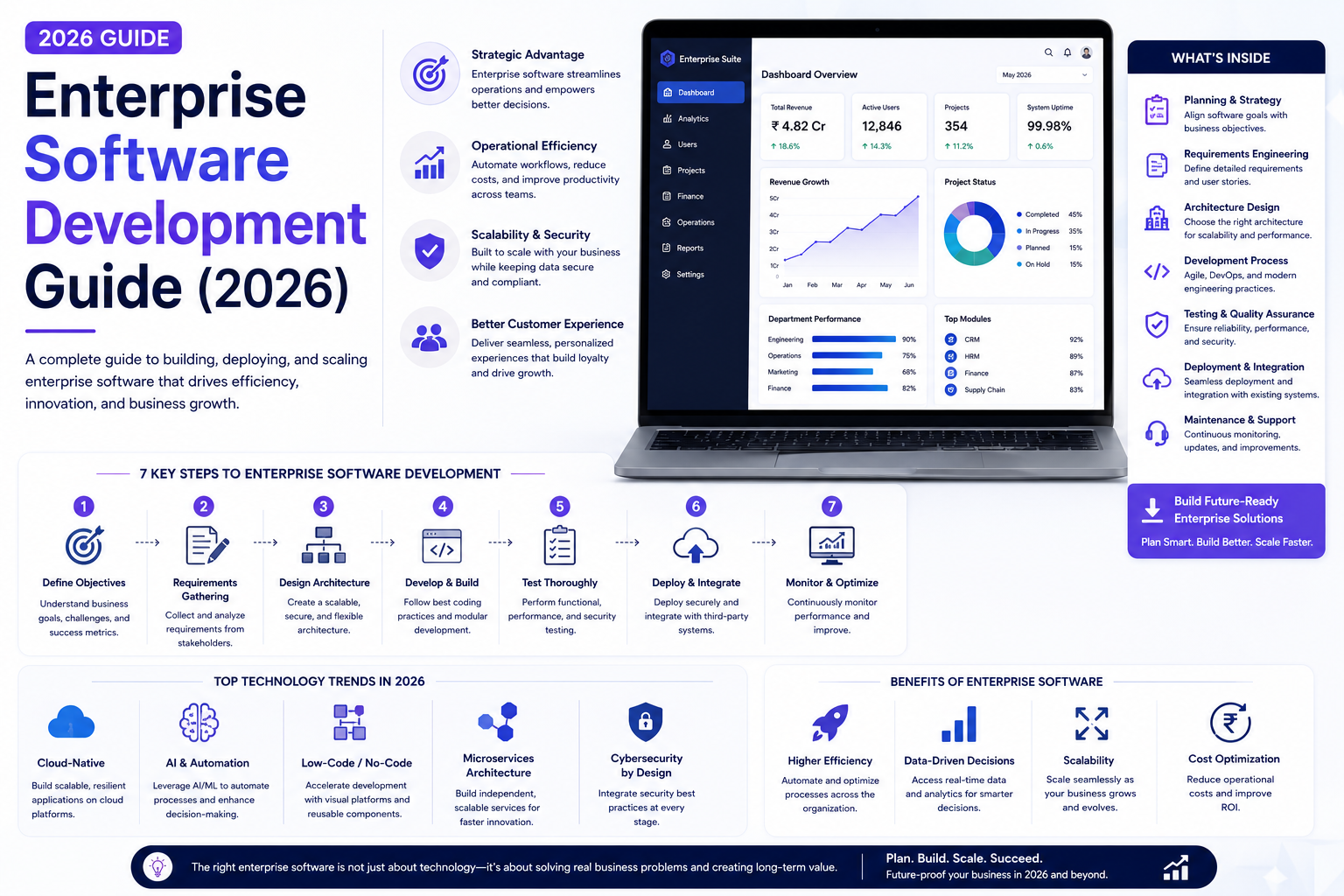

Complete guide to enterprise software development. Learn about architecture, security, compliance, scalability, integration, and best practices for building enterprise-grade applications.
Enterprise Software Development Guide (2026)
Enterprise software operates under different requirements than consumer applications — higher stakes, stricter security, complex integrations, and demanding scalability needs. This guide covers what makes enterprise software development distinct.
What Makes Enterprise Software Different
Scale. Enterprise software serves hundreds or thousands of users simultaneously, handles massive data volumes, and must maintain performance under load.
Security. Enterprise software manages sensitive data — financial records, personal information, trade secrets. Security is not optional; it is the foundation. Requirements include role-based access control, audit logging, encryption at rest and in transit, regular security audits, and compliance with regulations.
Integration. Enterprise software rarely exists in isolation. It must integrate with existing ERP, CRM, HR, and legacy systems. APIs, middleware, and data synchronization are central to enterprise architecture.
Reliability. Downtime costs enterprises lakhs or crores per hour. Enterprise software requires high availability (99.9%+ uptime), disaster recovery, and redundancy.
Compliance. Enterprises operate under regulatory frameworks — GDPR, HIPAA, SOC 2, ISO 27001, industry-specific regulations. Software must comply with applicable standards.
Enterprise Architecture Patterns
Microservices. Independent, loosely coupled services that can be developed, deployed, and scaled independently. Better for complex, evolving systems.
Monolithic. Single, unified application. Simpler to develop initially, harder to scale and maintain as complexity grows. Better for simpler systems with stable requirements.
Event-Driven Architecture. Services communicate through events rather than direct API calls. Enables loose coupling and real-time data flow across systems.
Enterprise Development Best Practices
Start with a thorough discovery phase — understand existing systems, workflows, and pain points. Design for scale from day one — retrofitting scalability is expensive. Prioritize security throughout development, not as an afterthought. Plan for integration with existing systems. Implement comprehensive logging and monitoring. Conduct regular security and performance testing. Document everything — enterprise systems outlive their original developers.
Why Choose RedGobble?
At RedGobble, we build high-performance digital products for startups, businesses, and enterprises. Our expertise includes custom website development, AI solutions, AI agent development, SaaS platforms, ERP and CRM systems, mobile app development, business automation, UI/UX design, SEO-friendly websites, and cloud deployment.
Based in Greater Noida, Uttar Pradesh, India, RedGobble provides custom software development, AI solutions, mobile app development, and web development services for businesses across India and worldwide.
Frequently Asked Questions
What is the difference between enterprise and regular software?
Enterprise software handles higher scale, requires stricter security and compliance, integrates with complex existing systems, and demands higher reliability and support standards.
How much does enterprise software cost?
Enterprise software development ranges from Rs 20,00,000 to Rs 2,00,00,000+ depending on complexity, scale, and integration requirements.
How long does enterprise software take to build?
6-18 months for most enterprise projects. The discovery and architecture phases take proportionally longer than in consumer software.
What is the biggest challenge in enterprise development?
Integration with existing legacy systems is typically the most challenging aspect — understanding decades-old systems, working within their constraints, and ensuring seamless data flow.
Why does enterprise software cost more?
Higher security requirements, complex integrations, scalability needs, compliance overhead, and the specialized expertise required all contribute to higher costs.
Conclusion
Enterprise software development demands higher standards across every dimension — architecture, security, scalability, and reliability. The investment is significant but delivers systems that power organizations for years or decades.
Ready to start your project? [Book a Free Consultation](/contact) with the RedGobble team today.