ERP vs CRM: What's the Difference? (2026 Complete Comparison)
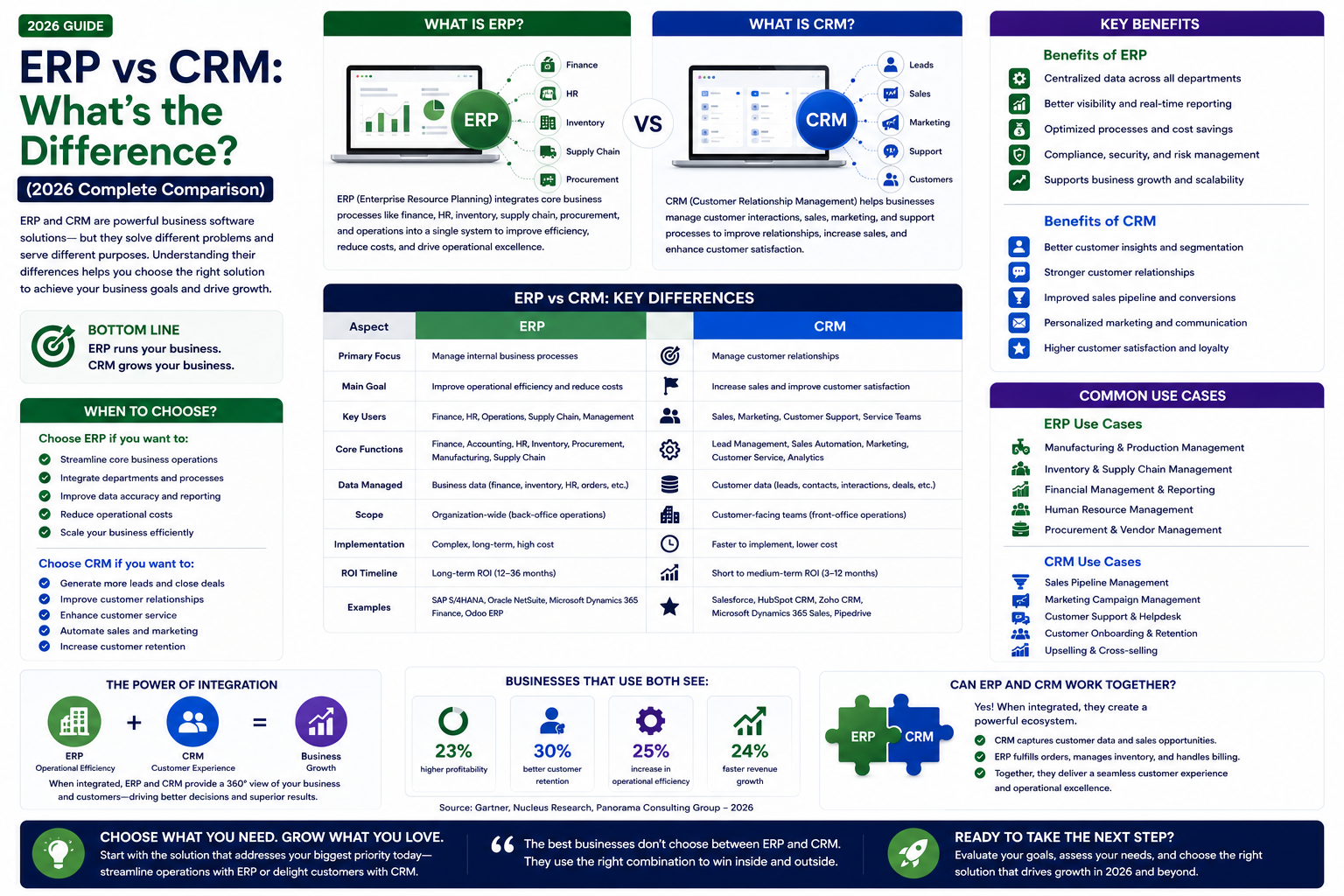

Understand the key differences between ERP and CRM systems. Learn which to implement first, how they complement each other, and how integration between ERP and CRM benefits your business.
ERP vs CRM: What's the Difference? (2026 Comparison)
ERP (Enterprise Resource Planning) and CRM (Customer Relationship Management) are two of the most important business software categories — but they serve fundamentally different purposes. Understanding the difference helps you invest in the right system at the right time.
What Is ERP?
ERP integrates internal business operations — finance, HR, inventory, supply chain, manufacturing — into one unified system. It focuses on operational efficiency: doing things better, faster, and cheaper. ERP answers questions like "What is our cash flow?", "How much inventory do we have?", and "What are our labour costs?"
What Is CRM?
CRM manages external customer relationships — sales, marketing, customer service — in one place. It focuses on revenue growth: acquiring customers, closing deals, and retaining relationships. CRM answers questions like "Which deals are closing this month?", "How effective was our last campaign?", and "Which customers need attention?"
ERP vs CRM Comparison
| Aspect | ERP | CRM |
|---|---|---|
| Primary Focus | Internal operations | Customer relationships |
| Key Users | Finance, HR, Operations, Manufacturing | Sales, Marketing, Customer Service |
| Core Function | Operational efficiency | Revenue growth |
| Data Managed | Financial, inventory, HR, production | Contacts, deals, campaigns, tickets |
| Integration | Connects internal departments | Connects customer-facing teams |
| ROI Measured By | Cost reduction, process efficiency | Revenue increase, customer retention |
Do You Need ERP, CRM, or Both?
You need a CRM if: You want to improve sales efficiency and pipeline visibility. Your marketing needs better campaign tracking and lead management. Your customer service team needs a centralized support system. Customer relationships are the primary driver of your business growth.
You need an ERP if: Your internal operations are complex and fragmented across spreadsheets and disconnected tools. You need real-time visibility into finances, inventory, and operations. Manual processes are slowing your business down. You are scaling and current systems cannot keep up.
You need both if: Your business has grown beyond what spreadsheets and basic tools can handle. Sales, operations, and finance need to work from the same data. You want end-to-end visibility from customer acquisition through order fulfillment and support.
ERP and CRM Integration
Many businesses start with a CRM to improve sales, then add an ERP as operations become more complex. Modern systems often integrate ERP and CRM so that a closed deal in CRM automatically triggers order fulfillment in ERP, customer service in CRM can check inventory in ERP, and finance in ERP can see sales pipeline from CRM for better forecasting.
Why Choose RedGobble?
At RedGobble, we build high-performance digital products for startups, businesses, and enterprises. Our expertise includes custom website development, AI solutions, AI agent development, SaaS platforms, ERP and CRM systems, mobile app development, business automation, UI/UX design, SEO-friendly websites, and cloud deployment.
Based in Greater Noida, Uttar Pradesh, India, RedGobble provides custom software development, AI solutions, mobile app development, and web development services for businesses across India and worldwide.
Frequently Asked Questions
Which should I implement first — ERP or CRM?
CRM first, for most businesses. It directly impacts revenue generation. ERP becomes essential as operational complexity grows.
Can ERP and CRM be the same system?
Some platforms offer both, but they serve different purposes. Integration between separate best-of-breed ERP and CRM systems often provides the best of both worlds.
How much do ERP and CRM cost?
CRM starts around Rs 1,000-5,000/user/month for off-the-shelf. ERP is typically more expensive due to broader scope. Custom development for either varies widely based on requirements.
Do small businesses need ERP?
Not typically. Small businesses benefit most from CRM first, adding ERP when operations become complex enough that spreadsheets are no longer manageable.
How long does ERP/CRM implementation take?
Off-the-shelf CRM can be set up in days to weeks. Custom ERP development takes months. Plan implementation carefully — rushing leads to poor adoption.
What are the biggest implementation mistakes?
Implementing without clear requirements, inadequate user training, poor data migration, trying to do everything at once instead of phased rollout, and ignoring user feedback.
Conclusion
ERP and CRM serve complementary but distinct purposes. CRM drives revenue growth through better customer relationships. ERP drives efficiency through integrated operations. Most growing businesses benefit from both, implemented in the right sequence with proper integration between them.
Ready to start your project? [Book a Free Consultation](/contact) with the RedGobble team today.