How Startups Can Build an MVP Successfully (2026 Guide)
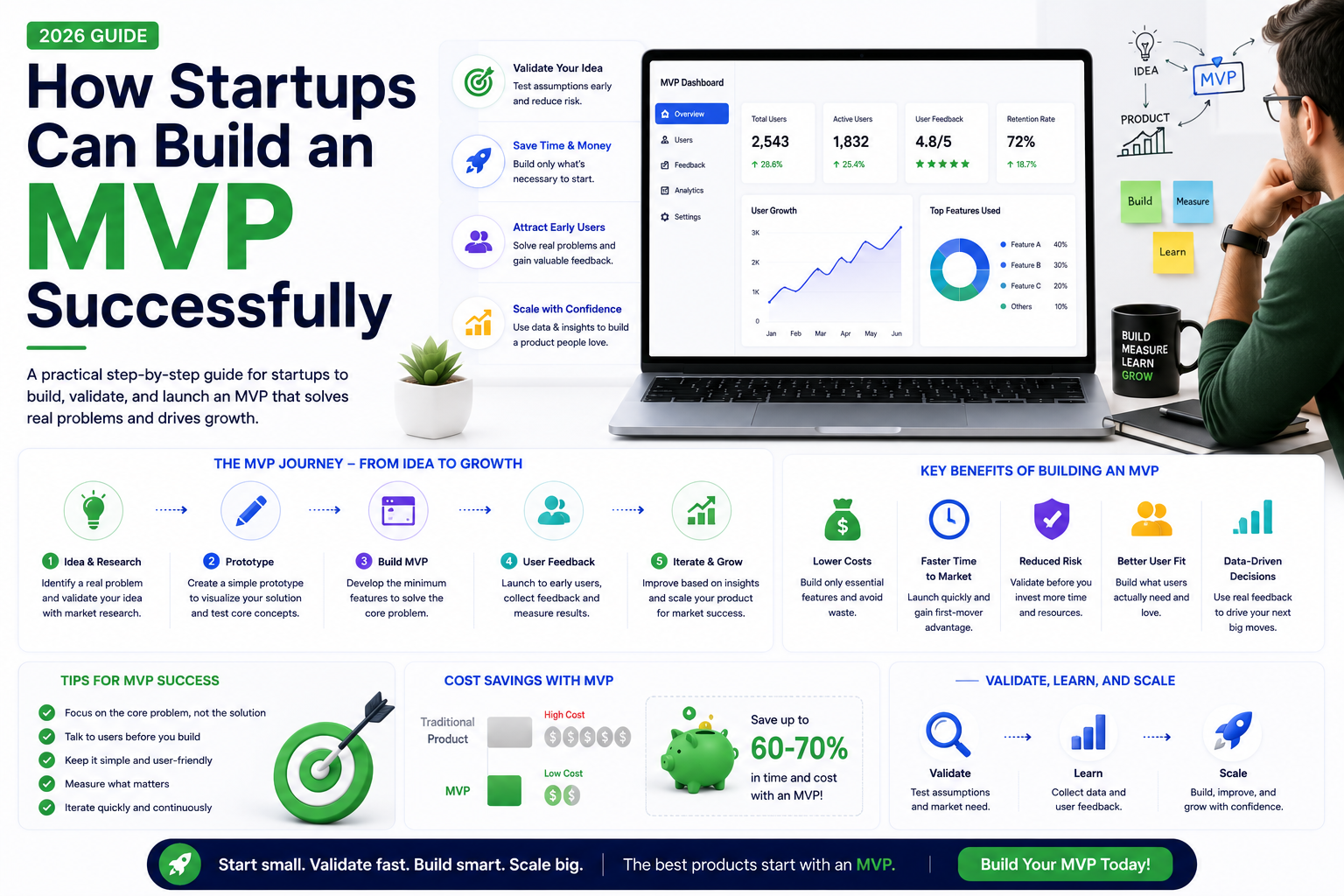

Learn how to build a successful Minimum Viable Product (MVP) that validates your idea, attracts early users, and provides actionable feedback without wasting resources.
How Startups Can Build an MVP Successfully (2026 Guide)
An MVP (Minimum Viable Product) is the simplest version of your product that delivers value to early adopters and provides validated learning about your market. Building an MVP correctly saves time, money, and heartbreak. This guide shows you how.
What an MVP Is (and Is Not)
An MVP is the smallest thing you can build that lets you learn whether customers want your product. It is not a half-finished product. It is not a low-quality product. It is the simplest complete solution to a real problem.
Step 1: Define Your Core Hypothesis
What assumption are you testing? Example: Small business owners will pay for a tool that automates invoice generation. Your MVP should test this specific hypothesis — nothing more.
Step 2: Identify Your One Core Feature
What is the single feature without which your product makes no sense? Everything else goes on the roadmap for later. If you cannot identify one core feature, you have not narrowed your focus enough.
Step 3: Define Success Metrics
How will you know if your MVP is successful? Sign-ups? Active users? Revenue? Retention after 30 days? Define measurable success criteria before you build.
Step 4: Build Fast
Choose technologies that enable rapid development — Next.js, Supabase, Vercel. Use existing libraries and services instead of building from scratch. Skip features that are nice-to-have. Your goal is speed, not perfection.
Step 5: Launch to Real Users
Get your MVP in front of real users as quickly as possible. Friends and family feedback is not validation. Find users who have the problem you are solving and pay attention to what they actually do, not just what they say.
Step 6: Measure, Learn, Iterate
Analyze user behavior. What features do they use? Where do they drop off? What do they request? Use this data to decide: persevere (keep building), pivot (change direction), or kill (the idea is not working).
Common MVP Mistakes
Building too much — adding features because they feel important delays launch and wastes resources. Building too little — an MVP must deliver real value, not just a landing page. Ignoring design — an MVP should look professional enough to build trust. Not measuring — if you are not tracking user behavior, you are not learning. Talking to the wrong users — validate with people who actually have the problem you are solving.
Why Choose RedGobble?
At RedGobble, we build high-performance digital products for startups, businesses, and enterprises. Our expertise includes custom website development, AI solutions, AI agent development, SaaS platforms, ERP and CRM systems, mobile app development, business automation, UI/UX design, SEO-friendly websites, and cloud deployment.
Based in Greater Noida, Uttar Pradesh, India, RedGobble provides custom software development, AI solutions, mobile app development, and web development services for businesses across India and worldwide.
Frequently Asked Questions
What is an MVP in simple terms?
An MVP is the simplest version of your product that solves a real problem for real users — enough to validate your idea and learn what to build next.
How much does an MVP cost?
An MVP typically costs Rs 3,00,000 - Rs 8,00,000 depending on complexity. This investment validates your idea before committing to full development.
How long does it take to build an MVP?
8-16 weeks for most software MVPs. The goal is to launch and learn quickly, not build a perfect product.
What features should my MVP include?
Only the features absolutely essential to solve the core problem. If a feature is nice-to-have, it belongs on the post-MVP roadmap.
How do I know if my MVP is successful?
Define success metrics before building — sign-ups, active users, revenue, retention, or specific user behaviors. Measure against these criteria after launch.
What happens after the MVP?
Analyze user behavior and feedback. If validated, build the next most important features. If not validated, pivot or explore a different approach.
Conclusion
A well-executed MVP validates your idea, attracts early adopters, and provides the foundation for your full product — all while minimizing wasted time and resources. Build less, learn more, iterate faster.
Ready to start your project? [Book a Free Consultation](/contact) with the RedGobble team today.