Startup Technology Guide: Where to Invest First (2026)
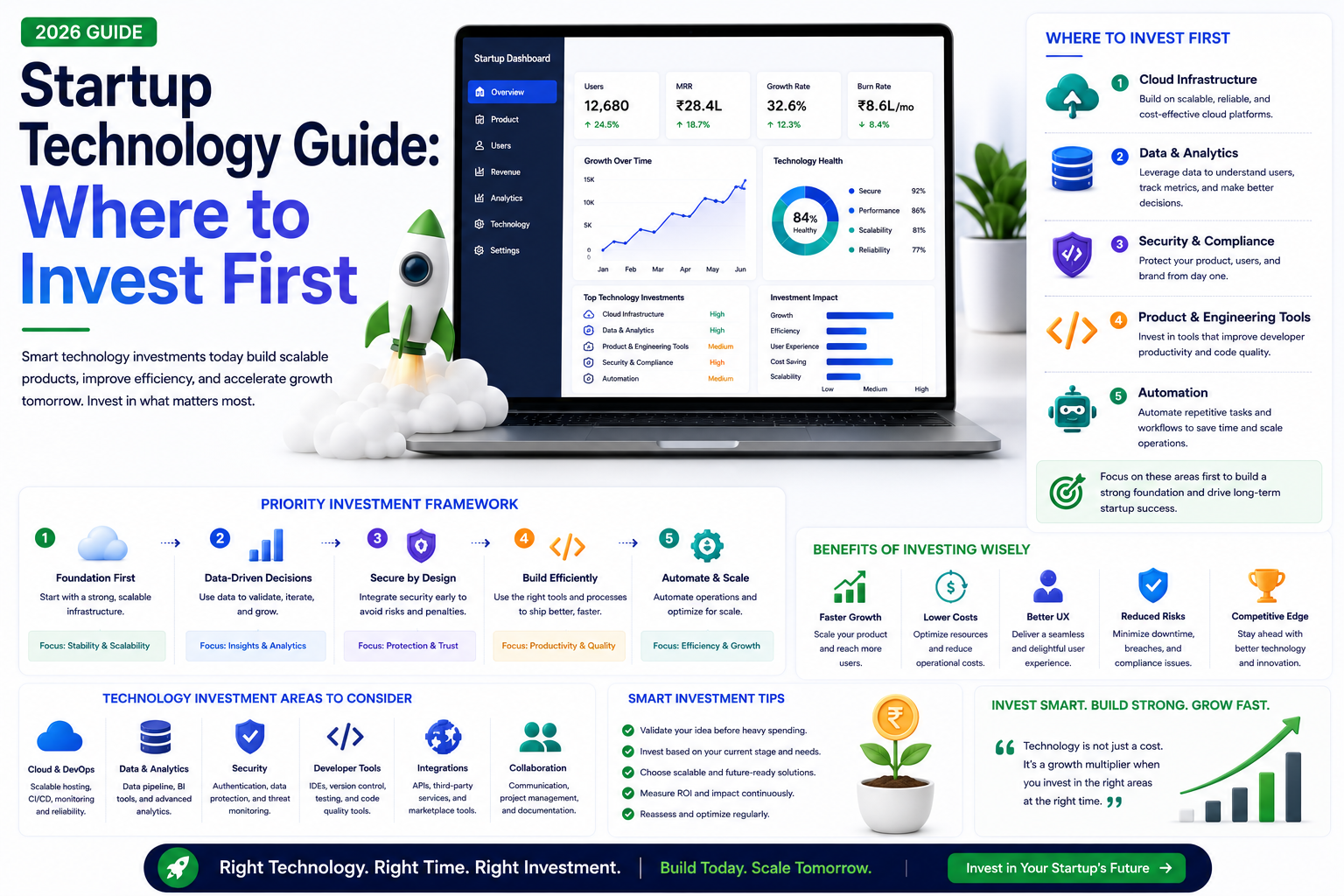

Strategic guide for startups on where to invest technology budget first. Learn to prioritize website, MVP, CRM, automation, and infrastructure investments for maximum impact.
Startup Technology Guide: Where to Invest First (2026)
Startups operate with limited resources. Every rupee spent on technology must deliver maximum impact. This guide helps you prioritize technology investments based on your stage and goals.
Priority 1: Professional Website
Your website is your digital storefront, sales representative, and credibility builder — all in one. It is the first place potential customers, investors, and partners will look. Invest in: Custom design reflecting your brand. SEO optimization to be discoverable. Fast loading with modern frameworks (Next.js). Mobile responsiveness. Clear messaging and CTAs. Lead capture (contact forms, newsletter signup).
Budget: Rs 50,000 - Rs 2,00,000 for a professional business website.
Priority 2: Minimum Viable Product (MVP)
If you are building a software product, your MVP is the simplest version that delivers value and validates your idea. Focus on the one core feature that differentiates you. Everything else can wait. Launch quickly, gather real user feedback, then iterate.
Budget: Rs 3,00,000 - Rs 15,00,000 depending on product complexity.
Priority 3: CRM and Customer Communication
Even at early stages, you need to manage customer relationships. Start with affordable tools like HubSpot (free tier) or Zoho CRM. Automate follow-up emails. Track leads and deals. As you grow, custom CRM development provides tailored capabilities at scale.
Budget: Free to Rs 5,000/month for off-the-shelf. Custom CRM starts at Rs 5,00,000.
Priority 4: Analytics and Data
You cannot improve what you do not measure. Install Google Analytics 4 from day one. Set up conversion tracking. Monitor user behavior, acquisition channels, and retention. Data-driven decisions separate successful startups from those that fail.
Budget: Free (Google Analytics) to Rs 10,000/month for advanced analytics.
Priority 5: Automation
As you grow, automate repetitive tasks — email sequences, invoicing, data entry, reporting. Start with no-code tools (Zapier, Make) and graduate to custom automation as needs become more complex.
Budget: Rs 1,000-10,000/month for tools. Custom automation from Rs 50,000.
What Not to Invest In (Yet)
Do not build custom ERP until you have significant operational complexity. Do not build mobile apps before validating with a web product. Do not invest in expensive enterprise software when simpler tools suffice. Do not over-engineer your tech stack before you have product-market fit.
Why Choose RedGobble?
At RedGobble, we build high-performance digital products for startups, businesses, and enterprises. Our expertise includes custom website development, AI solutions, AI agent development, SaaS platforms, ERP and CRM systems, mobile app development, business automation, UI/UX design, SEO-friendly websites, and cloud deployment.
Based in Greater Noida, Uttar Pradesh, India, RedGobble provides custom software development, AI solutions, mobile app development, and web development services for businesses across India and worldwide.
Frequently Asked Questions
What technology should a startup invest in first?
A professional website and, if building a product, an MVP focused on your core differentiator. These establish your presence and validate your idea with minimal investment.
How much should a startup spend on technology?
Early-stage startups typically allocate 15-25% of their budget to technology. This increases as the product matures and technology becomes core to the business.
Should we build a mobile app as a startup?
Not initially. Validate your idea with a web product first. Build a mobile app when your users demand it and you have product-market fit.
What tech stack should a startup use?
Modern, productive stacks — Next.js, Node.js, PostgreSQL, Vercel/Supabase. These provide excellent performance, fast development, and easy scaling.
How do we choose between building and buying?
Buy for standard, non-differentiating needs (email, CRM, accounting). Build for your core differentiator — the thing that makes your startup unique.
Conclusion
Smart technology investment can accelerate your startup's growth. The key is prioritizing ruthlessly — invest in what directly impacts your core business and defer everything else until you have validated the need.
Ready to start your project? [Book a Free Consultation](/contact) with the RedGobble team today.