What is RAG? Retrieval-Augmented Generation Explained (2026 Guide)

Learn what Retrieval-Augmented Generation (RAG) is, how RAG pipelines work with embeddings and vector databases, and when to choose RAG over fine-tuning for AI applications.
What is RAG? Retrieval-Augmented Generation Explained (2026 Guide)
Large language models are impressive, but they have a fundamental limitation: they only know what was in their training data, and that data has a cutoff date. Ask a model about your company's internal policies, your current product catalog, or yesterday's sales numbers, and it will either hallucinate an answer or admit it does not know.
Retrieval-Augmented Generation — RAG for short — solves this problem by giving the model access to a knowledge base at answer time. Instead of relying on memorized training data, the model retrieves relevant documents and generates answers grounded in those documents.
What Is RAG?
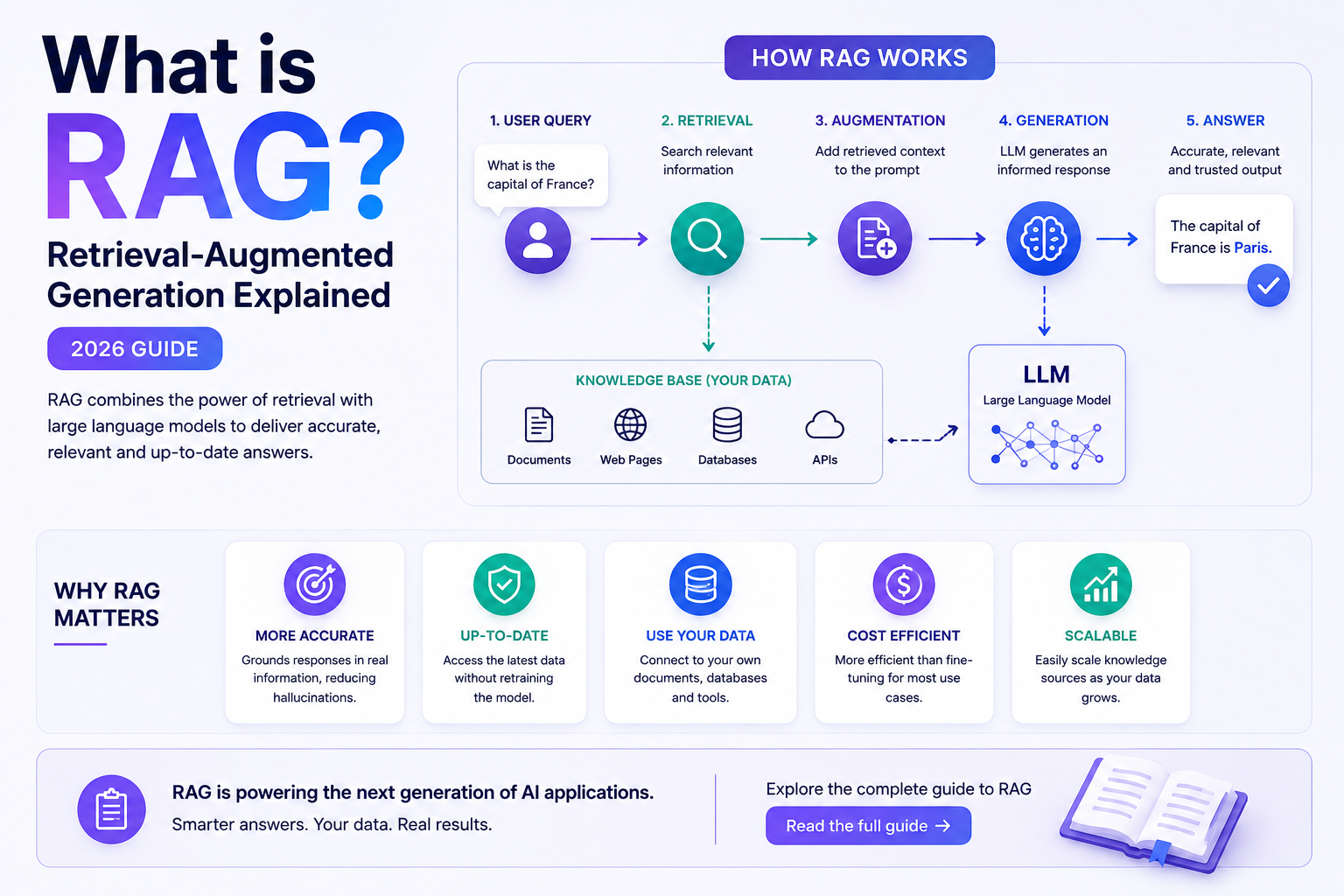
RAG is an AI architecture that combines a retrieval system with a generative model. When a user asks a question, the system:
1. Converts the question into a search query (usually an embedding).
2. Retrieves the most relevant chunks of text from a knowledge base.
3. Passes those chunks to the LLM as context.
4. The LLM generates an answer based on the retrieved context.
The result is answers that are grounded in your data, current, and traceable. This is why RAG became the default architecture for production AI assistants — chatbots, support agents, internal knowledge tools.
Why RAG Matters
Accuracy and grounding. The model answers from retrieved evidence rather than memory, dramatically reducing hallucinations for factual questions.
Fresh data without retraining. The knowledge base updates instantly. Add a new policy document, update a product page, and the assistant reflects it immediately — no model retraining required.
Traceability. Because answers cite retrieved chunks, you can show users where an answer came from and audit responses.
Privacy and access control. You keep your data in your own store and control what gets retrieved per user, which is far better for sensitive business data than sending everything to a generic model.
Cost and speed. RAG is cheaper and faster to iterate than fine-tuning. You pay for retrieval plus a standard generation call.
How a RAG Pipeline Works
A production RAG system has two phases.
Indexing phase (built once, updated continuously):
1. Ingest documents — PDFs, web pages, internal wikis, database rows, support tickets.
2. Clean and structure the text.
3. Chunk documents into pieces of a few hundred tokens, sized for retrieval quality.
4. Generate embeddings — vector representations — for each chunk.
5. Store chunks and embeddings in a vector database.
Query phase (per user question):
1. Embed the user's question.
2. Search the vector database for the most similar chunks, by embedding distance.
3. Optionally blend in keyword search or metadata filters — hybrid search.
4. Optionally re-rank results to keep the best context.
5. Send the top chunks plus the question to the LLM.
6. Return a grounded answer, with citations to the retrieved chunks.
Core Components
Embeddings. Models that convert text into vectors where similar meanings sit close together. Choosing the right embedding model strongly affects retrieval quality.
Vector databases. Specialized stores that index embeddings and support fast similarity search. Popular options include pgvector (on PostgreSQL), Supabase, and dedicated vector databases. Many teams run pgvector to keep retrieval in their existing database stack.
Chunking strategy. How you split documents matters more than most people expect. Overlapping chunks, section-aware chunking, and metadata tagging improve retrieval precision.
Retrieval strategy. Options range from simple top-k similarity to hybrid search (vector plus keyword) and re-ranking with a cross-encoder model. For many business assistants, hybrid search plus top-k is a strong, pragmatic default.
The LLM call. The generation step uses a system prompt that instructs the model to answer only from the provided context and to say when information is not present.
RAG vs Fine-Tuning
These are complementary techniques, not competitors. Fine-tuning changes the model's behavior and style by training on examples; it does not reliably inject new facts. RAG supplies facts at answer time.
| Aspect | RAG | Fine-Tuning |
|---|---|---|
| Purpose | Ground answers in a knowledge base | Change tone, format, or behavior |
| Data freshness | Instant | Requires retraining |
| Fact injection | Strong | Weak |
| Cost to update | Low | High |
| Hallucination control | Strong | Limited |
| Best for | FAQs, policies, product data, support | Brand voice, structured output, specialized style |
The common pattern in production: fine-tune when you need a specific style or structured behavior, then layer RAG on top for the facts.
Common RAG Challenges
Retrieval misses. The right answer exists but the search does not find it. Fixes: better chunking, hybrid search, re-ranking, richer metadata.
Context dilution. Too much irrelevant text in the prompt degrades accuracy. Fixes: tighter retrieval, better prompts, smaller context windows.
Chunk boundary issues. An answer split across two chunks gets lost. Fixes: overlap, section-aware chunking.
Stale index. Data updated but index not refreshed. Fixes: incremental indexing and pipelines tied to content changes.
Evaluation. You cannot improve what you do not measure. Build a small evaluation set of real questions with expected answers, and track retrieval hit-rate and answer correctness over time.
When to Use RAG
Use RAG for support chatbots grounded in help center and policy documents, employee assistants that answer from the internal wiki and handbook, product assistants that answer from live catalogs and pricing, compliance and audit assistants that must cite sources, and domain experts in healthcare, legal, finance, or engineering where accuracy is critical.
At RedGobble, every production AI assistant we ship is grounded with a RAG pipeline over the client's own knowledge base. Human oversight and traceable answers are core standards in our AI development approach. To understand how these systems differ from simple bots, see our guide on AI chatbots vs AI agents — or explore the AI Development service for how we scope and build RAG systems.
Frequently Asked Questions
What does RAG stand for in AI?
Retrieval-Augmented Generation. The model retrieves relevant context from a knowledge base before generating an answer.
How is RAG different from fine-tuning?
RAG supplies facts at answer time from a searchable knowledge base. Fine-tuning adjusts the model's behavior through training. They are complementary — fine-tune for style, use RAG for facts.
Do I need a vector database for RAG?
You need a way to search embeddings. Many teams run pgvector on an existing PostgreSQL/Supabase database rather than adding a separate vector store.
Is RAG better than fine-tuning for chatbots?
For factual, knowledge-based questions, RAG is usually better — it is cheaper to update, easier to trace, and more effective at stopping hallucinations.
How do I reduce hallucinations in RAG?
Retrieve better context (hybrid search, re-ranking), instruct the model to answer only from context, and say no when the answer is absent.
How do I measure RAG quality?
Track retrieval hit-rate and answer correctness on a fixed evaluation set of real questions, plus user feedback and escalation rates in production.
How often should I update my RAG knowledge base?
Whenever the underlying data changes — new policies, products, prices, or support articles. Incremental indexing keeps the system current without full re-indexing.