Mobile App Development Process Explained (2026 Complete Guide)
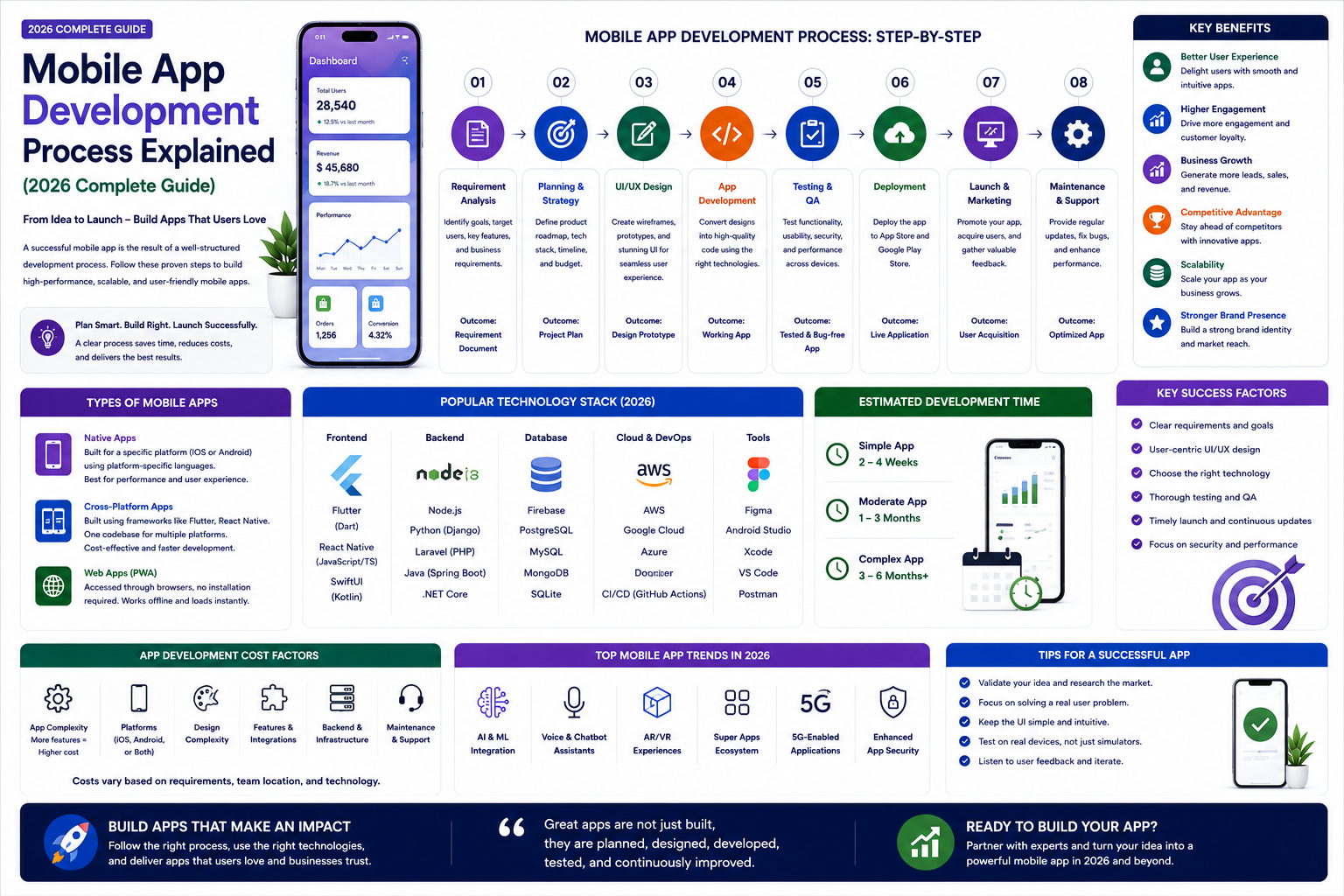

Learn the complete mobile app development process from strategy and UI/UX design to development, testing, launch, and post-launch maintenance. A step-by-step guide for businesses.
Mobile App Development Process Explained (2026 Complete Guide)
Building a successful mobile app requires more than coding — it demands a structured process that covers strategy, design, development, testing, launch, and ongoing improvement. Skipping any phase leads to budget overruns, delayed launches, or apps that fail to engage users.
Phase 1: Strategy and Discovery
Before any design or development, define the app's purpose. Who is your target user? What problem does the app solve? What are the key features for the initial launch (MVP)? What is the business model — paid app, in-app purchases, subscription, advertising, or free for existing customers? Competitive analysis: What similar apps exist? What do they do well? Where do they fall short? How will your app differentiate?
Phase 2: UI/UX Design
Design begins with user flow mapping — how users navigate through the app to accomplish key tasks. Wireframes sketch the layout of each screen without visual design. Interactive prototypes simulate the app experience for early testing and stakeholder feedback. High-fidelity UI design creates pixel-perfect screens with final colors, typography, icons, and animations.
Design principles: Simplicity — users should accomplish tasks with minimal taps. Consistency — similar actions should work similarly throughout the app. Feedback — every user action should provide visual or haptic feedback. Accessibility — design for users with varying abilities.
Phase 3: Technology Selection
Choose the right technology stack based on app requirements. Native development (Kotlin for Android, Swift for iOS) for maximum performance and platform-specific features. Cross-platform (Flutter/Dart) for building both Android and iOS from one codebase, saving 30-40% in cost and time.
Backend: Firebase or Supabase for rapid development with managed services. Custom Node.js/Python backend for complex business logic and custom APIs. Database: PostgreSQL, Supabase, or MongoDB depending on data structure needs.
Phase 4: Development
Development is typically structured in sprints (1-2 week cycles) following agile methodology. Each sprint delivers working, tested features. Regular demos keep stakeholders informed and allow course correction.
Frontend development builds the UI, navigation, animations, and user interactions. Backend development creates APIs, databases, authentication, business logic, and admin panels. Integration work connects third-party services — payment gateways, maps, analytics, push notifications, social logins.
Phase 5: Testing and Quality Assurance
Thorough testing ensures a polished, bug-free experience. Functional testing verifies every feature works as designed. Usability testing with real users identifies friction points. Performance testing ensures smooth 60fps animations and fast load times. Security testing validates authentication, data encryption, and API security. Device testing across multiple screen sizes and OS versions. Beta testing through TestFlight (iOS) and Google Play Console (Android) with real users.
Phase 6: Launch and Deployment
App Store Optimization (ASO): Optimized title, description, keywords, screenshots, and preview video for both stores. Prepare privacy policy, terms of service, and support URL. Submit to Apple App Store (review takes 1-3 days) and Google Play Store (review takes a few hours to a few days). Plan a launch strategy — press releases, social media announcements, influencer outreach, paid acquisition campaigns.
Phase 7: Post-Launch and Maintenance
Monitor analytics — user acquisition, retention, session duration, crash reports. Collect and prioritize user feedback for future updates. Regular updates for OS compatibility and bug fixes. A/B test features and designs to optimize user experience. Continuous improvement based on data and user feedback.
App Development Timeline
| App Type | Timeline (Flutter) |
|---|---|
| Simple MVP | 6-10 weeks |
| Business App | 12-20 weeks |
| E-commerce App | 16-26 weeks |
| Social/On-Demand App | 20-36 weeks |
| Enterprise App | 24-52 weeks |
Why Choose RedGobble?
At RedGobble, we build high-performance digital products for startups, businesses, and enterprises. Our expertise includes custom website development, AI solutions, AI agent development, SaaS platforms, ERP and CRM systems, mobile app development, business automation, UI/UX design, SEO-friendly websites, and cloud deployment.
Based in Greater Noida, Uttar Pradesh, India, RedGobble provides custom software development, AI solutions, mobile app development, and web development services for businesses across India and worldwide.
Frequently Asked Questions
What is the first step in mobile app development?
Strategy and discovery — defining target users, core problem to solve, MVP features, business model, and competitive differentiation.
How long does it take to build a mobile app?
Simple apps take 6-10 weeks. Business apps take 12-20 weeks. Complex apps with advanced features take 20-52 weeks.
What is an MVP in app development?
Minimum Viable Product — the simplest version of your app that solves the core problem. MVPs launch faster, cost less, and provide real user feedback before investing in full development.
Should I build native or cross-platform?
Cross-platform (Flutter) is recommended for most business apps — it saves 30-40% in cost and time while delivering near-native performance. Native is preferred for apps requiring maximum performance or platform-specific features.
How much user testing should I do?
Test with at least 5-10 real users before launch. Usability issues surface quickly — you do not need hundreds of testers to find the biggest problems.
What happens after the app launches?
Ongoing monitoring, user feedback collection, regular updates for OS compatibility, bug fixes, and feature enhancements based on data and user requests.
Do I need a backend for my app?
Most apps need a backend for user accounts, data storage, APIs, and admin functionality. Firebase and Supabase provide managed backends that reduce development time.
How do I get my app discovered?
App Store Optimization (ASO), social media marketing, content marketing, influencer partnerships, paid user acquisition, and PR outreach.
Conclusion
A structured mobile app development process transforms your idea into a polished, successful product. From strategy through design, development, testing, and launch — each phase builds on the previous one. Partnering with an experienced development team ensures your app is built right the first time, saving time, money, and frustration.
Ready to start your project? [Book a Free Consultation](/contact) with the RedGobble team today.